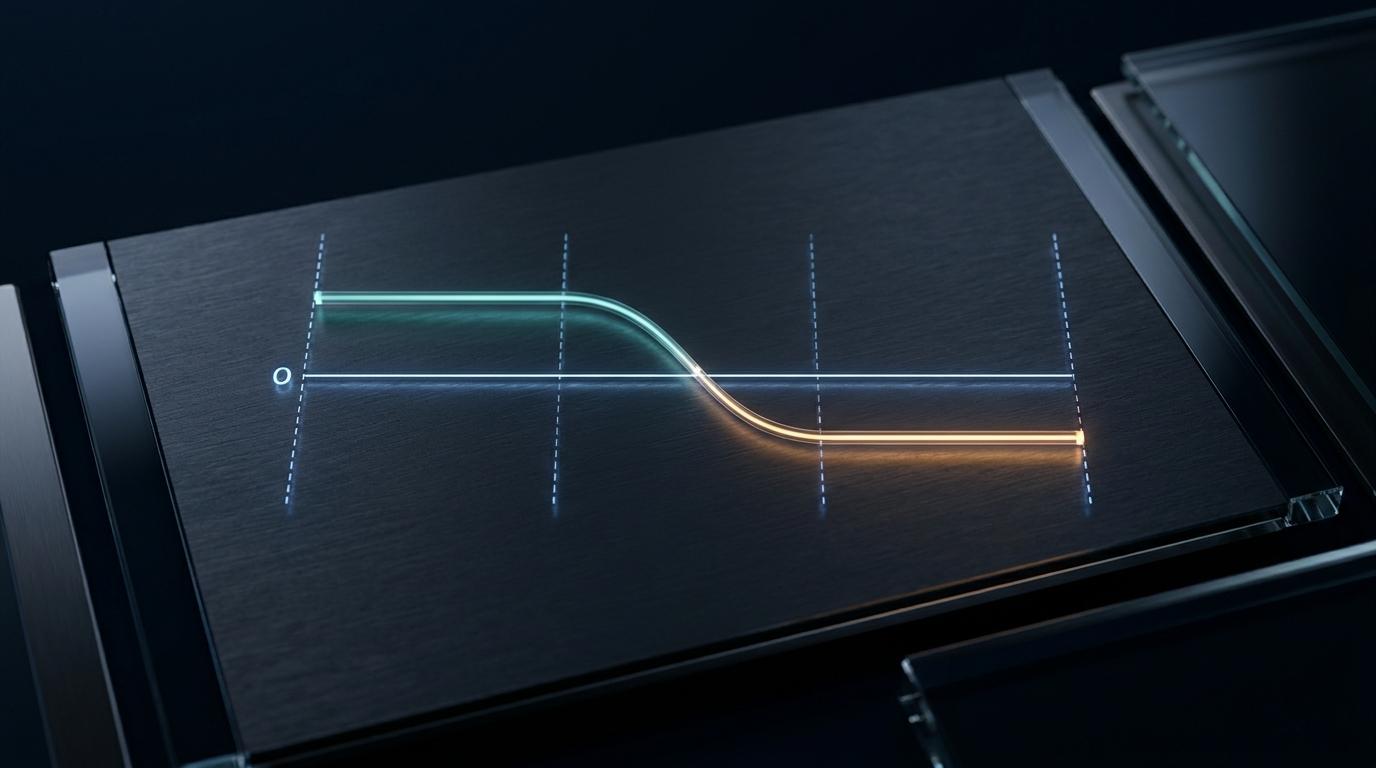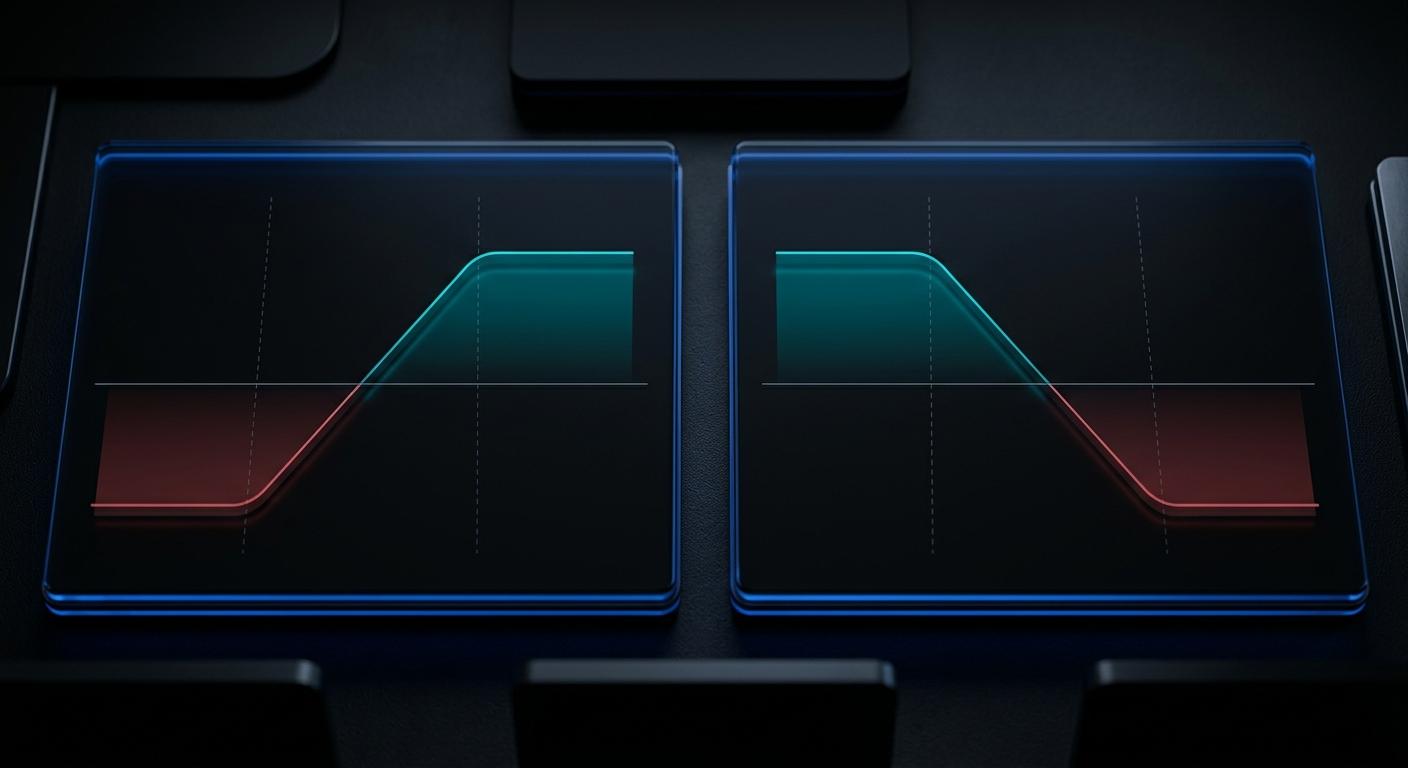
You have a view on NVDA into next month and two tickets open on the screen. One buys the 185 call and sells the 195 against it, costing you money up front. The other sells the 400 put on MSFT and buys the 390 to cap the damage, paying you money up front. Both are vertical spreads, both risk a fixed amount, and both can be right. The credit spread vs debit spread decision isn't about which structure is better, it's about whether you're being paid to wait or paying for movement.
A debit spread needs the stock to go somewhere to make money. A credit spread makes money if the stock does nothing, and that single difference drives everything else: the win rate, the size of the win, how implied volatility affects you, and whether time is your ally or your opponent. Both sit in the vertical family, the first real step past single-leg trades in the full options strategies guide, because they replace unlimited-ish payoffs with a known ceiling and a known floor.
What makes a spread a vertical
Same underlying, same expiration, same option type, two different strikes. You buy one and sell one. That's it. The sold leg pays for part of the bought leg, which lowers your cost and your risk, and in exchange it caps how much the position can ever make.
Which strike you buy and which you sell decides whether cash lands in your account or leaves it:
- Debit spread: the option you buy is more expensive than the option you sell. Net cash goes out. Your maximum loss is the debit paid.
- Credit spread: the option you sell is more expensive than the option you buy. Net cash comes in. Your maximum loss is the width between the strikes minus the credit received.
Four combinations exist, and each has a bullish and a bearish version. Bull call spread and bear put spread are debits. Bull put spread and bear call spread are credits.
How a debit spread works
Say NVDA trades at $180 and you think it grinds toward $200 over the next month. Buying the 185 call outright costs more than you want to risk, so you sell the 195 call against it and bring the net cost down to $3.20, or $320 per spread.
Your risk is that $320 and nothing more. Your maximum gain is the $10 width minus the $3.20 debit, so $680. Breakeven sits at $188.20, the long strike plus what you paid. Above $195 at expiration, both legs are in the money and the spread is worth its full $10 no matter how far NVDA runs, which is the trade-off you accepted when you sold the upper call. The Options Industry Council's walkthrough of the bull call spread lays out the same math with a profit diagram if you want to see the shape.
The bearish mirror is a bear put spread: buy the 175 put, sell the 165, pay a debit, and profit as the stock falls toward the lower strike.
What a debit spread really is: a cheaper directional bet with a ceiling. You're risking less than the outright long option and giving up the tail in return.
How a credit spread works
MSFT trades at $420 and you don't think it breaks $400 in the next three weeks. Sell the 400 put, buy the 390 put as protection, collect $2.40 in net credit.
You keep the $240 if MSFT closes above $400. Your maximum loss is the $10 width minus the $2.40 credit, so $760, which happens if MSFT is below $390 at expiration. Breakeven is $397.60. Notice what you're being paid for: the stock can rise, sit still, or drift down almost 5% and you still win. Three outcomes out of four pay you. That's the appeal, and it explains why put credit spreads are a staple for traders who like a high hit rate.
The call-side version works the same way from above. With COIN near $280, selling the 300 call and buying the 310 might pay $3.00: a $300 maximum profit against $700 of risk, profitable as long as the crypto-linked name stays under $300. That structure, the bear call spread, is how you express "not above here" without shorting anything.
What a credit spread really is: a bet on a range, with the premium as your payment for defining where the stock won't go.
Credit spread vs debit spread side by side
Debit spread | Credit spread | |
|---|---|---|
Cash at entry | Paid out | Received |
Maximum loss | The debit paid | Width minus the credit |
Maximum gain | Width minus the debit | The credit received |
Needs the stock to | Move toward your strikes | Stay away from your short strike |
Typical win rate | Lower | Higher |
Typical win size | Larger | Smaller |
Time decay | Works against you | Works for you |
Rising implied volatility | Mildly helpful | Mildly harmful |
Early assignment risk | Minimal | Real on the short leg |
The two columns are closer than they look. A bull call spread at the 185/195 strikes and a bull put spread at the same strikes have nearly identical payoff curves, because put-call parity makes them economically equivalent. That equivalence runs through most defined-risk spread strategies: the same payoff can often be built more than one way, and what separates the versions is assignment risk, how much capital the broker holds, and whether you'd rather hold a small position that usually wins or one that usually loses but pays well when it hits.
Choosing between them
Direction gets all the attention, but it's only one of three inputs that matter in options trading, alongside implied volatility and your tolerance for being wrong often.
Pick a debit spread when:
- You have a clear directional view with a timeframe attached. "AMD above 190 by the April expiration," not "AMD looks good."
- Implied volatility is on the low side, so you're buying premium cheaply.
- You want a favorable risk-reward ratio: risking $320 to make $680 only needs to work roughly a third of the time to break even.
- You'd rather lose small and often than lose big occasionally.
Pick a credit spread when:
- Your view is a boundary rather than a target. You're more confident about where the stock won't go than where it will.
- Implied volatility is elevated, so the option you're selling is richly priced and any IV contraction helps you.
- You want time to be on your side every day the stock sits still.
- You can stomach the asymmetry: collecting $240 against $760 of risk means one full loss wipes out three wins.
That last point is the one traders underrate. A credit spread that wins 75% of the time and pays 1:3 is roughly break-even before commissions. The edge has to come from your strike selection or your read on volatility, not from the high win rate itself.
What implied volatility does to each
Vertical spreads are less sensitive to volatility than single options, because the long and short legs partly cancel each other out. Partly, not entirely. The leg closer to the money carries more vega, so the net position still leans one way.
Debit spreads are usually net long vega. A volatility expansion helps, a collapse hurts. Credit spreads are usually net short vega, which is why selling them into an inflated IV environment and watching premium drain after the event is such a common playbook. If you're selling a spread across an earnings report, you're relying on IV crush more than you may realize, and a stock that moves against you can turn that quickly.
Elevated IV also widens the market's expected range, which pushes the strikes that pay a given credit further out. That's genuinely useful: higher IV lets you sell further from the money for the same money.
Time decay cuts both ways
Theta is a cost for debit spreads and income for credit spreads, but neither is linear. A debit spread with both strikes out of the money bleeds steadily as expiration approaches. Push it in the money and decay starts working in your favor, because the short leg is losing value faster than the long one.
Credit spreads collect decay fastest in the final two weeks, which is why so many traders open them at 20 to 45 days out and close at 50% of maximum profit rather than holding to the end. Gamma rises sharply in the last few days, and a short strike that was comfortably safe on Monday can be breached by Wednesday on one headline.
Where verticals sit among other strategies
Spreads are the middle ground between buying premium outright and selling it naked. If you want pure movement with no directional view, a long straddle buys a call and a put at the same strike and profits from a big move either way, with no capped upside and no short leg working against you. The cost is a much larger premium outlay.
Widen those strikes and you get a strangle, cheaper to buy and, when sold, the undefined-risk cousin of a credit spread. A short strangle collects more than a comparable iron condor but leaves the tails open, which is exactly what the long wings of a defined-risk structure exist to prevent.
Combine a put credit spread and a call credit spread on the same underlying and you've built an iron condor, a range trade with two short strikes instead of one. The logic doesn't change; you've simply doubled the premium and the number of ways to be wrong.
On the stock-based side, a covered call does something similar to a bear call spread economically, except the shares play the role of the long call and you need the capital to hold them. The income is comparable, the capital requirement is not.
The same comparison holds for a cash-secured put against a put credit spread. Both are bullish-to-neutral and both collect premium. The spread ties up a few hundred dollars of defined risk where the cash-secured put ties up the full strike value, so the return on capital is far higher and the maximum loss far smaller. What you give up is the ability to be assigned shares you actually wanted.
Mistakes that cost money on both sides
Selling a credit spread purely because the win rate looks good. A 90% probability trade that pays 1:9 has no edge. Check what you're collecting relative to the width before you look at the probability.
Going too wide, too soon. A $10-wide spread on a $600 index risks $900 or more per contract. On a QQQ position, a $2 or $3 width often expresses the same idea with a quarter of the risk.
Ignoring the short leg on dividend dates. American-style equity options can be assigned early, and a short in-the-money call is most at risk the day before a stock goes ex-dividend. Index products like SPX and XSP are European-style and cash-settled, so the problem disappears entirely.
Holding into expiration with the stock pinned between strikes. If one leg finishes in the money and the other doesn't, you end up with an unwanted stock position over the weekend. Closing the spread for a few cents of slippage is cheaper than finding out.
Buying a debit spread so far out of the money that it's a lottery ticket. If the long strike is already past the expected move, the structure is cheap for a reason.
FAQs
Is a credit spread safer than a debit spread?
No. Both have defined maximum losses, and the credit spread's is usually the larger of the two. A $10-wide credit spread collecting $2.40 risks $760 to make $240. The debit spread version of the same view might risk $320 to make $680. "Safer" depends on how you size the position, not on which direction the cash flows at entry.
Which has a higher probability of profit?
Credit spreads, almost always, because they profit from a range of outcomes rather than one. That advantage is already priced in. The market charges you for the higher hit rate by paying you less when you're right.
How much capital does each tie up?
A debit spread costs the debit, and that's the whole requirement. A credit spread requires the width minus the credit, held until you close the position or it expires. Neither needs margin in the borrowing sense; the risk is fully defined at entry.
Can I convert one into the other mid-trade?
You can't convert a position, but you can close one and open the other. More usefully, you can roll a credit spread out in time or further from the money for an additional credit when the short strike comes under pressure, as long as you're not just adding risk to avoid taking a loss.
Are spreads better than buying calls and puts outright?
For a strong, fast move, a single long call captures more. For grinding or range-bound tape, the spread wins because the short leg pays for the waiting. Vertical spreads also keep position cost predictable, which matters a lot when you're trading to a drawdown limit.
What expiration works best?
Debit spreads generally want enough time for the thesis to play out, often 30 to 60 days. Credit spreads tend to be opened in the 20 to 45 day window and closed early, where decay is quick but gamma hasn't gone vertical yet.
Both structures belong in a toolkit, and the choice usually settles itself once you've been honest about what you actually believe. A conviction about where price is going points to a debit; a conviction about where price isn't going points to a credit.
At Vanquish, multi-leg trades including both types of vertical sit on the Advanced Options plan's Level 4 permissions, where SPX, XSP and VIX are limited to single-leg calls and puts. The other plans are built around buying calls and puts outright.
Working out the credit spread vs debit spread question on a funded account changes the calculus a little, since a defined maximum loss is also a defined worst day against your drawdown. If you'd like to put either structure to work under published rules, compare the plans and pick the permissions that match how you trade.