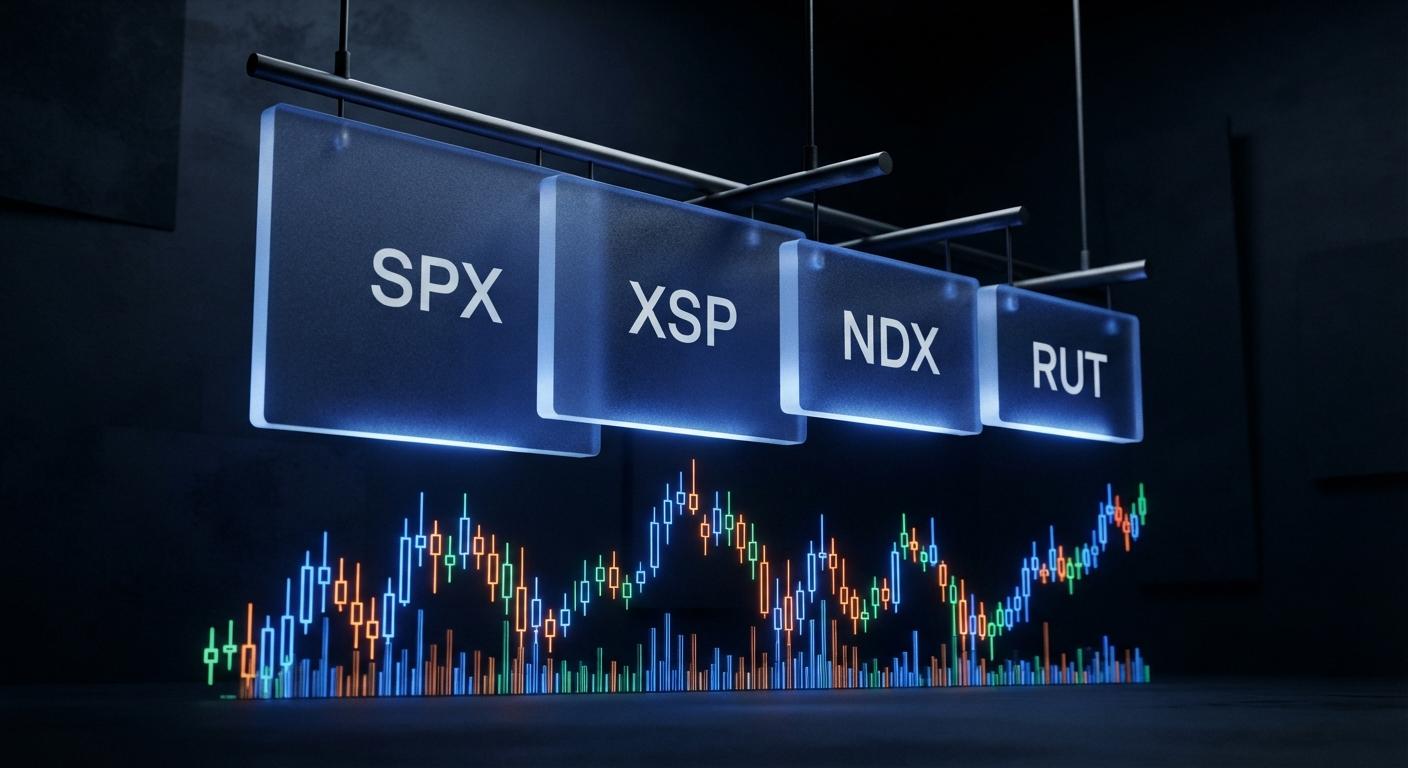
An index option is a contract on a number, not on shares. Buy an SPX call and there is no stock behind it: at expiration the contract settles to cash based on where the S&P 500 index prints, and the position simply disappears from your account. That one structural difference — cash settlement instead of share delivery — is what separates SPX, XSP, NDX and RUT from the single-stock contracts most traders start with.
Everything else you already know about options still applies. Calls still gain when the underlying rises, puts still gain when it falls, premium still decays, and implied volatility still moves prices around. Index options just package that exposure in a bigger, cleaner, cash-settled wrapper that happens to be where most of the serious short-dated volume now lives.
What an index option actually is
Indexes like the S&P 500, Nasdaq-100 and Russell 2000 are calculations, not tradable assets. You cannot own the S&P 500 directly. What you can own is a derivative whose value is tied to the index level, and an index option is exactly that: the right to receive the difference between the index level and your strike at expiration, multiplied by the contract multiplier.
Almost every listed index option uses a $100 multiplier, so the notional value of one contract is the index level times $100. The practical effect is size. A single SPX contract controls roughly ten times the notional of an SPY contract, which is why one SPX position can replace a basket of smaller trades — and why one bad SPX trade can do ten times the damage.
Cash settlement and European exercise
Two features define index options, and both work in the trader's favor once you understand them.
Cash settlement. There is no share delivery, no assignment of 100 shares, no stock position appearing overnight in a margin account you did not plan for. An in-the-money contract converts to its cash value at expiration; an out-of-the-money contract expires worthless.
European exercise. Index options can only be exercised at expiration, never before. Short index positions cannot be assigned early, which removes an entire category of risk that short stock and ETF options carry — especially around dividends, where American-style ETF calls can be exercised early by whoever wants the payout.
There is one wrinkle worth knowing. Traditional monthly SPX contracts settle to a special opening quotation (SET), calculated from the opening prices of all 500 component stocks on the third Friday morning. Because the components do not all open at once, that settlement value often differs from any price the index actually displayed. Weekly and daily contracts, along with the PM-settled monthly series, settle to the 4:00 p.m. closing level instead. The distinction matters most around quarterly expiration weeks, when open interest in those AM-settled series is at its heaviest.
Broad-based index options also fall under Section 1256 of the tax code, which generally splits gains 60% long-term and 40% short-term regardless of holding period. That treatment does not apply to ETF options on SPY or QQQ, and it is one reason active traders migrate to the index products over time.
The main index products
Product | Tracks | Multiplier | Settlement | Exercise |
|---|---|---|---|---|
SPX | S&P 500 | $100 | Cash (AM for traditional monthlies, PM otherwise) | European |
XSP | S&P 500 at 1/10 the size | $100 | Cash, PM | European |
NDX | Nasdaq-100 | $100 | Cash | European |
XND | Nasdaq-100 at 1/100 the size | $100 | Cash | European |
RUT | Russell 2000 | $100 | Cash | European |
SPX
SPX is the deepest index options market in the world and the center of gravity for short-dated trading. Expirations are listed for every trading day of the week, strikes are five points apart in the liquid range, and the top-of-book spreads near the money are tight enough to trade actively. The size is the main obstacle for smaller accounts: a near-the-money weekly contract can easily cost several thousand dollars in premium. The structural trade-offs between the index and the ETF are worth working through before you commit, and we lay them out side by side in SPX vs SPY options.
XSP
XSP solves the sizing problem. It is the Mini-SPX contract, built at one-tenth the notional of SPX while keeping cash settlement, European exercise and Section 1256 treatment. Strikes land close to SPY's price range, so a trader used to SPY can switch with very little mental adjustment. Liquidity is thinner than SPX or SPY — spreads widen away from the money, and you should expect to work orders rather than hit the market — but Cboe's Mini-SPX product page lists the same daily and weekly expiration cycle, including same-day contracts. For an account that wants index mechanics without six-figure notional per trade, xsp options are the cleanest answer available.
NDX
NDX tracks the Nasdaq-100, which means concentrated exposure to the large-cap technology complex: AAPL, MSFT, NVDA, AMZN, META and the rest of the index's top weights drive most of its movement. It is the highest-notional of the common index products and carries noticeably higher implied volatility than SPX, because the underlying basket is less diversified. XND, at one-hundredth the size, exists for traders who want the same exposure in retail-sized clips.
RUT
RUT tracks the Russell 2000 and behaves like a different animal. Small caps are more sensitive to interest rates, credit conditions and domestic economic data, and RUT frequently diverges from SPX for weeks at a time. Volume is a fraction of SPX's, spreads are wider, and the weekly expiration schedule is less complete — but for traders who want a genuine macro expression rather than another way to be long technology, it fills a gap nothing else does.
Index options versus ETF options
The honest comparison comes down to four things:
- Size. SPX and NDX are large. XSP, XND and ETF contracts like SPY or QQQ are not. Position sizing, not preference, usually decides this one.
- Settlement. Index options settle to cash with no early assignment. ETF options can be assigned at any time, and short calls get exercised around ex-dividend dates.
- Tax. Index options generally receive 60/40 treatment; ETF options do not.
- Liquidity. SPY has the tightest penny-wide spreads in the market. SPX is close behind in dollar terms but quotes in five-cent increments. XSP, XND and RUT trade with visibly wider markets.
Traders who are building toward larger size, holding multi-leg structures, or trading SPY options at a volume where assignment risk starts to bite tend to end up in the index products eventually.
Expirations, 0DTE and the daily cycle
The explosion in same-day trading happened in the index complex first. SPX now offers an expiration every single trading day, which means there is always a contract with hours of life left and a delta that moves violently with the index. Same-day index contracts carry no overnight gap risk and no assignment risk, and they are the reason the 0DTE options market has grown into a majority share of SPX volume.
That convenience cuts both ways. Gamma near expiration is extreme, a two-point move in the index can double or halve a contract's value in minutes, and theta drains premium through the session in a way that punishes hesitation. The sizing discipline that zero days to expiration trading demands is doubly important in the index complex, where one contract carries ten times the notional of its ETF equivalent, and where index 0DTE rewards planned entries and exits far more than it rewards conviction.
Reading the flow in index products
Because index options are where institutions hedge, the order flow carries information that single-stock flow often does not. Large SPX put purchases weeks out are usually portfolio insurance rather than a directional bet, and misreading one as the other leads to bad conclusions. Learning to separate hedging from speculation is a large part of interpreting unusual options activity in index names.
Open interest clusters matter too. SPX strikes at round numbers accumulate enormous open interest, and dealer hedging around those strikes can pin or repel price into expiration. The max pain concept is a rough way of looking at that concentration — imperfect as a forecast, useful as a map of where the structural pressure sits.
Risks that come with the territory
Index options remove assignment risk but add others. Notional size is the obvious one: a single SPX contract moves in hundreds of dollars per index point, so an undersized account can take a full-day loss in a few minutes. Liquidity is the second. XSP, XND and RUT look like their larger siblings until you need to exit a position quickly in a fast tape, and the fill you get is not the one on the screen.
Volatility risk is the third. Index implied volatility is tightly linked to the VIX, and a sharp spike repricing the entire surface can hurt a long options position even when direction was right — or, more commonly, crush a position after the spike fades. Trading the index means trading volatility whether you intended to or not.
FAQs
Can you trade index options in a small account?
Yes, through the mini contracts. XSP at one-tenth of SPX and XND at one-hundredth of NDX bring premium outlay down to levels a $10,000 account can manage, while keeping cash settlement and European exercise.
Do index options expire worthless more often?
No more often than any other option. The distribution of outcomes is similar; what changes is what happens when they finish in the money. There is no stock position to manage, just a cash credit or debit at settlement.
Why do SPX and SPY prices differ by roughly 10x?
SPY is designed to trade at about one-tenth of the S&P 500 index level. The index option and the ETF option reference the same underlying market, but one contract on SPX covers ten times the notional of one SPY contract.
Are index options always cash-settled?
The broad-based index options listed in the US — SPX, XSP, NDX, XND, RUT and similar products — are cash-settled and European-style. Options on index ETFs such as SPY, QQQ and IWM are not; those deliver shares and can be exercised early.
Which index product has the best liquidity?
SPX, by a wide margin, especially in the near-dated expirations. NDX is liquid but with wider spreads, XSP is workable with limit orders, and RUT requires patience on entries and exits.
Pick the product that matches your account size rather than the one with the most volume. XSP gives you index mechanics at a size you can actually manage; SPX gives you the tightest market in the world if you have the capital behind it; NDX and RUT offer exposure nothing else replicates. Every Vanquish plan lets you buy calls and puts on index options the same way you would on any other ticker, with SPX, XSP and VIX limited to single-leg positions on Advanced Options. Have a look at the plans and the drawdown that fits how you trade.