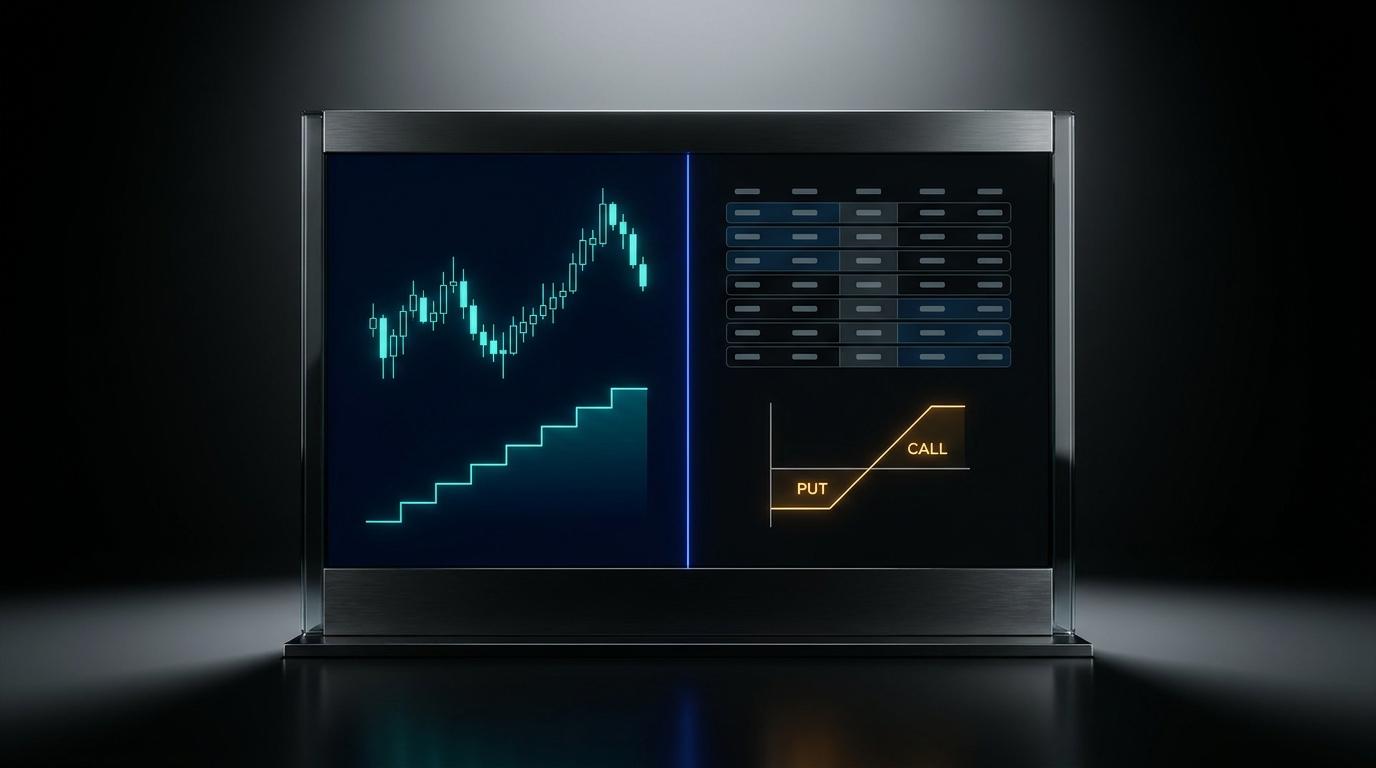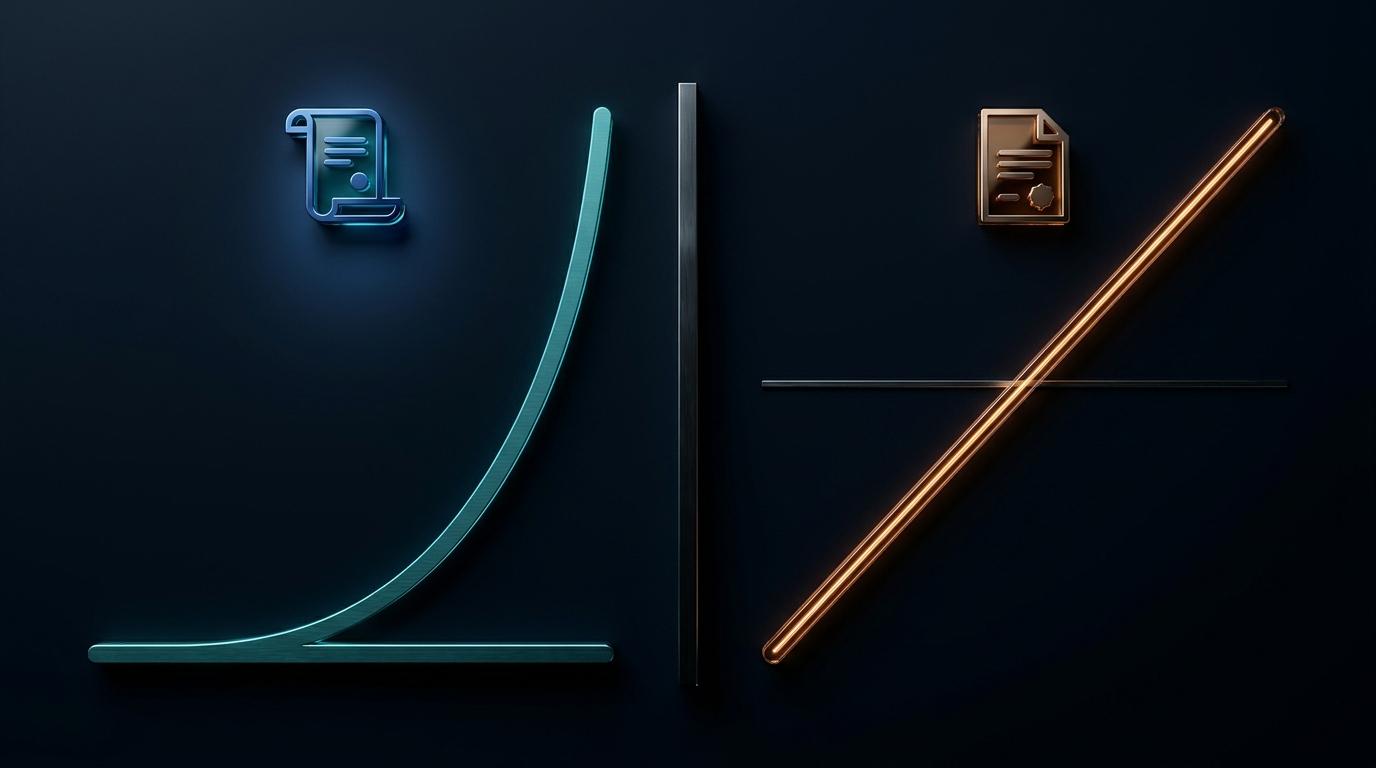
If you're choosing between two markets for day trading, the short version is this: futures give you a straight-line position with symmetrical risk, and options give you a curved one where the most you can lose on a long contract is what you paid. The options vs futures decision usually comes down to whether you want that curve, and whether you're willing to pay for it in time decay. Both are derivatives, both are exchange-traded and centrally cleared, and both can be traded intraday with a small account. After that they behave almost nothing alike, which is why the comparison matters more than the surface similarity suggests. If contracts, strikes and expirations are new to you, the groundwork in our guide to how options work will make the rest of this easier to follow.
What a futures contract actually is
A futures contract is a binding agreement to buy or sell a standardized quantity of something at a set price on a set date. Equity index futures like the E-mini S&P 500 (ES) and its micro version (MES) are cash-settled, so nobody delivers anything, but the obligation is still real while you hold the position. Price moves one tick, your account moves by the tick value. There's no decay, no strike to choose and no expiration cliff until the contract rolls.
The money you put up isn't a purchase price. It's a performance bond, and the CFTC's explanation of how futures margin and offsetting work spells out why that distinction matters: positions are marked to market daily, and if your equity falls below maintenance margin, you post more or the position gets reduced. That's the structural difference people miss. A losing futures trade can demand more money from you after the fact.
What an options contract gives you
Buying an option buys a right, not an obligation. Pay $3.20 for an NVDA call and $320 per contract is the entire amount at risk, no matter what the stock does overnight. That ceiling is the whole appeal, and it's also what you're paying for — the premium includes extrinsic value that bleeds away as expiration approaches, whether or not the underlying moves.
The tradeoff is complexity. A futures position has one variable: price. An option has price, time, implied volatility, and the way its own sensitivity to price shifts as any of those change. You can be directionally right on QQQ and still lose on a long call because volatility collapsed or you ran out of days. In exchange, you get tools futures can't offer: defined-risk spreads, positions that profit from a stock sitting still, and the ability to express "I think COIN moves big, I don't know which way" as a single trade.
Options vs futures at a glance
Futures | Options | |
|---|---|---|
What you hold | An obligation | A right (if long) |
Max loss on a long position | Theoretically unlimited | The premium paid |
Margin | Performance bond, marked to market daily | None needed to buy a long call or put |
Time decay | None | Works against long positions |
Payoff shape | Linear | Curved, and changes as conditions change |
Contract choice | One contract per expiration month | Dozens of strikes across many expirations |
Trading hours | Nearly round the clock, Sunday evening to Friday | US market hours, with some extended sessions |
Liquidity | Concentrated in the front month | Varies hugely by strike and expiration |
Typical learning curve | Shorter | Longer |
Risk: the difference that shows up fastest
Pick a bad entry in MES and the position keeps running against you until you close it or your stop fills. Gap risk is genuine, because the market trades overnight and your 9:30 a.m. screen can open well past where you'd planned to get out. Linear exposure cuts in both directions, which is exactly why futures traders live and die by stop discipline.
A long put or call behaves differently under stress. If SPY gaps against your position, the contract loses value but the loss stops at the premium. You don't get a margin call, and you can't owe more than you put in. That's a meaningful structural advantage for anyone trading an account with a hard drawdown limit, because the worst case on each position is knowable before you enter. Selling options naked flips this on its head — short calls carry the same open-ended risk profile futures do, which is why most evaluation programs restrict or forbid them.
Capital, cost and access
Futures win on capital efficiency in the narrow sense. Micro contracts let a small account take index exposure with a few hundred dollars of day-trading margin, and the cost per round turn is fixed and transparent. Options pricing is less uniform: you're paying commission plus the bid-ask spread, and a wide spread on an illiquid strike can cost you more than the commission ever will. Liquid names and index products keep that friction low; thinly traded single-stock chains don't.
Where options pull ahead is precision. You choose how much leverage you want by choosing a strike and an expiration, instead of accepting whatever notional the contract specifies. One contract of ES carries a fixed notional value. One SPX put can be a lottery ticket or a near-stock-equivalent position depending on where you place it, and that flexibility is worth a lot when you're sizing inside tight rules.
Which suits a prop trader better?
Futures have dominated prop trading for years, mostly because evaluation models were built around them first. Understanding how a prop firm funds and evaluates traders explains the pattern: a single, standardized contract with uniform tick value makes drawdown math simple to automate, so the first generation of firms standardized on futures and the industry followed.
That dominance is why so many of the names traders run into are futures-only. A firm like Tradeify builds its entire rule set around futures contracts, with scaling plans and micro-contract limits that only make sense in that market. If you want to trade options there, you can't — the platform doesn't offer them. Options traders got used to either converting their edge into futures or sitting out the prop model entirely.
That's changed, and it's worth comparing firms by what they actually let you trade rather than by headline account size. When you're weighing prop firms against each other, the instrument list is the first filter: a futures firm with excellent payout terms is useless to someone whose entire process runs off an options chain. Vanquish sits on the options side of that line, with every plan limited to options on US-listed underlyings and no margin or overnight positions at all.
How the rules differ once you're inside an evaluation
Drawdown behaves differently depending on what you trade. A futures position marks against you tick by tick, and in an intraday trailing account the unrealized swing can touch your loss limit before you've decided to exit. Long options can't put you in that position past the premium you paid, so the limit only moves against you as far as the contract can fall. That's not a free pass — ten overlapping long calls in correlated AI names will drain an account just fine — but it does change what a worst-case day looks like.
The other difference is time. Futures run nearly 23 hours, which tempts traders into sessions they have no edge in. Options trading is bounded by the US session, and under Vanquish rules everything closes by 3:59 p.m. ET anyway, so the day has a defined start and end. Traders who struggle with overtrading often find that boundary helpful, and the fundamentals section of our options library covers the mechanics you'll lean on inside those hours.
Frequently asked questions
Are futures easier to learn than options?
The mechanics are, yes. One price, one tick value, linear profit and loss — there's less to learn before you can place an intelligent trade. What's harder is survival, because the undefined downside punishes hesitation. Options demand more study upfront and are more forgiving of a single bad decision.
Can you lose more than you deposit trading options?
Not when you're buying them. A long call or put caps your loss at the premium. Selling options to open, or holding futures, is where losses can exceed what you put up, and that's precisely why firms draw the line there. Our broader options education hub goes deeper into which structures carry which risk profile.
Which market has better leverage?
Futures deliver more notional exposure per dollar of margin in a consistent way. Options can deliver far more on a percentage basis through out-of-the-money strikes, but that leverage comes with a much higher probability of total loss on the position. They're different kinds of leverage, not different amounts of it.
Do futures and options get taxed the same way?
Not necessarily. Futures and broad-based index options such as SPX fall under Section 1256 rules, while options on individual stocks generally don't. The difference is large enough to be worth raising with an accountant before you commit to one market.
Can you trade both at the same firm?
Some firms offer both, many don't. Vanquish is options-only across every plan, so futures aren't available — a deliberate choice, since the rule set, the drawdown math and the trading permissions are all built around options contracts rather than retrofitted from a futures model.
Framing options vs futures as a winner-takes-all contest misses the point. Futures reward precise execution in a linear market; options reward traders who can read volatility and time, and who want to know their worst case before they click. What should decide it is which one your process actually fits, and whether you can find a firm that trades it. If you're an options trader looking for an evaluation built for your instrument instead of adapted from someone else's, take a look at the Vanquish plans.