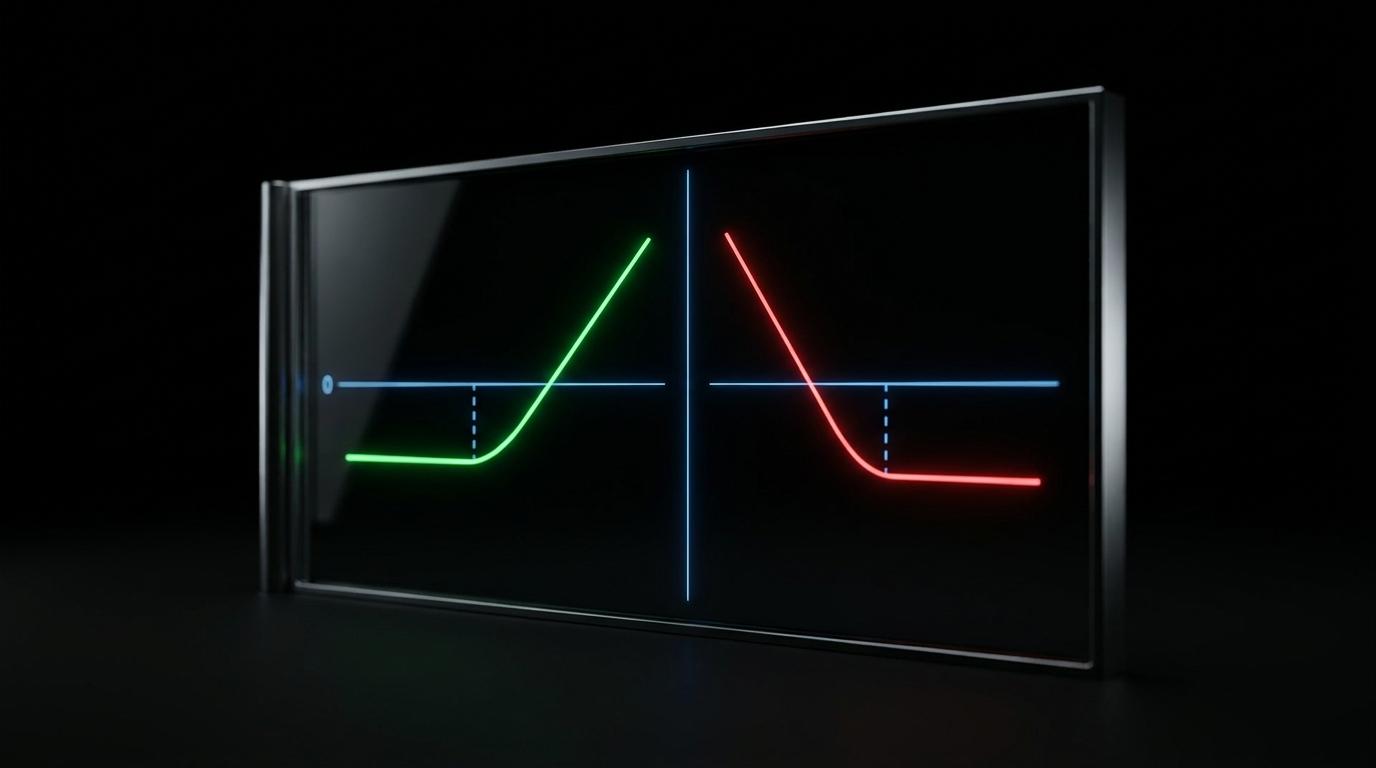
A call gives you the right to buy at a set price. A put gives you the right to sell at a set price. That single sentence covers most of what separates the two contracts, and everything else in the call vs put comparison is a consequence of it: which direction you profit, what your risk looks like, how the position reacts to a move, and when each one belongs in your plan.
The confusion usually starts a layer deeper. Calls and puts can each be bought or sold, which means there are four positions, not two, and "selling a call" behaves nothing like "buying a put" even though both lean bearish. If you're working through the fundamentals of how options work, getting this straight early saves a lot of pain later.
The core difference in one table
Both contracts control 100 shares of an underlying stock or ETF, both have a strike price and an expiration date, and both cost a premium. The rights they carry point in opposite directions.
Call option | Put option | |
|---|---|---|
Gives the buyer the right to | Buy 100 shares at the strike | Sell 100 shares at the strike |
Buyer wants the stock to | Rise | Fall |
Value increases when | Price goes up | Price goes down |
Delta (long position) | Positive, 0 to +1 | Negative, 0 to −1 |
In the money when | Stock is above the strike | Stock is below the strike |
Seller's obligation | Deliver shares at the strike | Buy shares at the strike |
The Options Industry Council keeps a plain-language version of the same breakdown in its options basics overview, which is worth bookmarking if the vocabulary is still new.
What a call option actually does
Say NVDA trades at $180 and you buy the $185 call expiring in three weeks for $4.20. You've paid $420 for the right to buy 100 shares at $185 any time before expiration. You don't have to buy them, and in practice almost nobody does — you sell the contract back for whatever it's worth.
Three things can happen:
- NVDA runs to $200. Your $185 call is $15 in the money. Intrinsic value alone is $1,500 against the $420 you paid.
- NVDA sits at $180. The contract bleeds out as expiration approaches and expires worthless. You lose the $420.
- NVDA drops to $165. Same outcome. You lose the $420, and not a dollar more.
That capped downside is the appeal of a long call. Your loss is the premium, your upside is open-ended, and your breakeven at expiration is strike plus premium — $189.20 in this example. The mechanics, including how to size and exit one, are covered in detail in the long call strategy guide.
What a put option actually does
Flip the direction. QQQ is at $480 and you buy the $470 put for $5.50, or $550. You now hold the right to sell 100 shares at $470. If QQQ slides to $450, that right is worth at least $2,000. If QQQ grinds higher or goes nowhere, the put decays and you lose the $550.
Puts do two jobs. The first is straightforward bearish speculation — you think a stock is overextended and you want to profit from the drop without shorting shares. The second is insurance: if you own 100 shares of AVGO and buy a put below the current price, you've set a floor on what that position can lose through expiration. Same contract, very different intent. The long put guide walks through both uses.
Four positions, not two
This is where the call vs put framing breaks down a little, because direction isn't determined by call-or-put alone. It's determined by call-or-put and buy-or-sell.
Position | Market view | Max profit | Max loss |
|---|---|---|---|
Long call | Bullish | Unlimited | Premium paid |
Long put | Bearish | Strike minus premium | Premium paid |
Short call | Bearish to neutral | Premium received | Theoretically unlimited |
Short put | Bullish to neutral | Premium received | Strike minus premium |
Notice the asymmetry. Buyers pay a premium and accept a defined loss in exchange for a large potential payoff. Sellers collect the premium and take on a much larger risk for a capped reward. A naked short call is the most dangerous of the four, because there's no ceiling on how far the underlying can run against you. A short put at least has a floor, since the stock can only go to zero.
Most traders start on the buying side for exactly that reason: the worst day is a known number.
How the two react to the same move
Delta is the cleanest way to see the difference. A long call has positive delta, so it gains when the underlying rises. A long put has negative delta, so it gains when the underlying falls. A 0.40-delta call picks up roughly $40 per contract on a $1 move up; a 0.40-delta put (quoted as −0.40) picks up roughly $40 on a $1 move down.
Where calls and puts behave identically is on everything that isn't direction:
- Time decay works against both buyers. Theta erodes a call and a put the same way, and it accelerates into the final weeks. Holding either contract through a quiet stretch costs money.
- Implied volatility inflates both. When implied volatility rises, calls and puts both get more expensive. Buying COIN options into an earnings report means paying for a move that's already priced in, and the volatility crush afterward can leave you with a loss even if you got the direction right.
- Strike selection drives everything. An out-of-the-money contract is cheap and usually expires worthless. A deeper in-the-money contract costs more and tracks the stock more closely. Our guide to choosing a strike price covers the tradeoff.
Those shared forces are why "I was right about the direction and still lost" is such a common complaint. Direction is one of several variables, and the options Greeks explain the rest.
Choosing between a call and a put
Start with the move you actually expect, not with the contract. A few practical filters:
- Direction. Up means call. Down means put. If you can't state which, you don't have a trade yet.
- Size of the expected move. Options need the underlying to travel far enough to cover the premium and the decay. A 1% drift won't pay for a two-week contract.
- Timing. Expiration has to sit beyond your expected move, with room to spare. Buying a Friday contract for a Monday thesis leaves no margin for being early.
- Volatility conditions. Buying into elevated IV means the move has to be bigger than the market already expects. Buying into calm IV is cheaper but often means nothing is happening.
One asymmetry worth knowing: puts on indexes and large-cap names usually cost more than equidistant calls, because institutions pay up for downside protection. That skew means a bearish SPY trade typically starts with a slightly steeper hill to climb than a bullish one of the same distance.
Mistakes that come up again and again
Treating a cheap contract as a cheap trade. A $0.30 far out-of-the-money call on HOOD isn't a bargain. It's a low-probability lottery ticket, and buying ten of them is a $300 position with a high chance of total loss.
Confusing "bearish" with "sell a call". Buying a put and selling a call both profit when price falls, but only one has defined risk. New traders who skip that distinction tend to find out the hard way.
Ignoring expiration day mechanics. Same-day contracts behave differently from weeklies — gamma is enormous and a position can swing from profitable to worthless in minutes. If that's where you're headed, read up on 0DTE options first.
Holding through the close. An in-the-money contract left to expire can turn into a share assignment you didn't plan for. Closing before expiration keeps the outcome in your hands.
FAQs
Is a put the same as shorting a stock?
Not quite. Both profit when the price falls, but a long put has a fixed cost and a known maximum loss, and it expires. Short stock has open-ended risk, requires borrowing shares, and has no expiration. The put also loses value to time decay, which short stock doesn't.
Can you lose more than you paid for a call or a put?
As a buyer, no. The premium is the maximum loss on a long call or a long put. As a seller, yes — a naked short call carries theoretically unlimited risk, and a short put can lose down to the strike price.
Which is better for beginners, calls or puts?
Neither is inherently safer. Buying either one caps your loss at the premium. What matters is whether you're buying or selling, and whether your position size is sensible. Many traders find calls easier to reason about first simply because upward moves are more intuitive.
Do calls and puts expire at the same time?
Yes. Both follow the same expiration calendar for a given underlying, whether that's weekly, monthly or, on index products, daily. Same-day listings, standard monthlies on the third Friday, and quarterly expirations apply to calls and puts alike.
Why did my call lose money when the stock went up?
Usually time decay, a volatility drop, or both. If the stock rose less than the market had priced in — common after an earnings release — the contract's extrinsic value can fall faster than its intrinsic value rises.
Once the call vs put distinction clicks, the rest of options trading opens up fast: spreads, hedges and income strategies are all built from these same two contracts in different combinations.
If you want to put that knowledge to work without risking your own money, every Vanquish plan lets you trade long calls and puts in a simulated account, with payouts tied to your results.