Advanced Options is the only Vanquish plan built for traders who do more than buy calls and puts. It unlocks Level 4 options, so you can sell premium, run credit spreads and iron condors, and write covered calls, in both the Evaluation and the Performance Account.
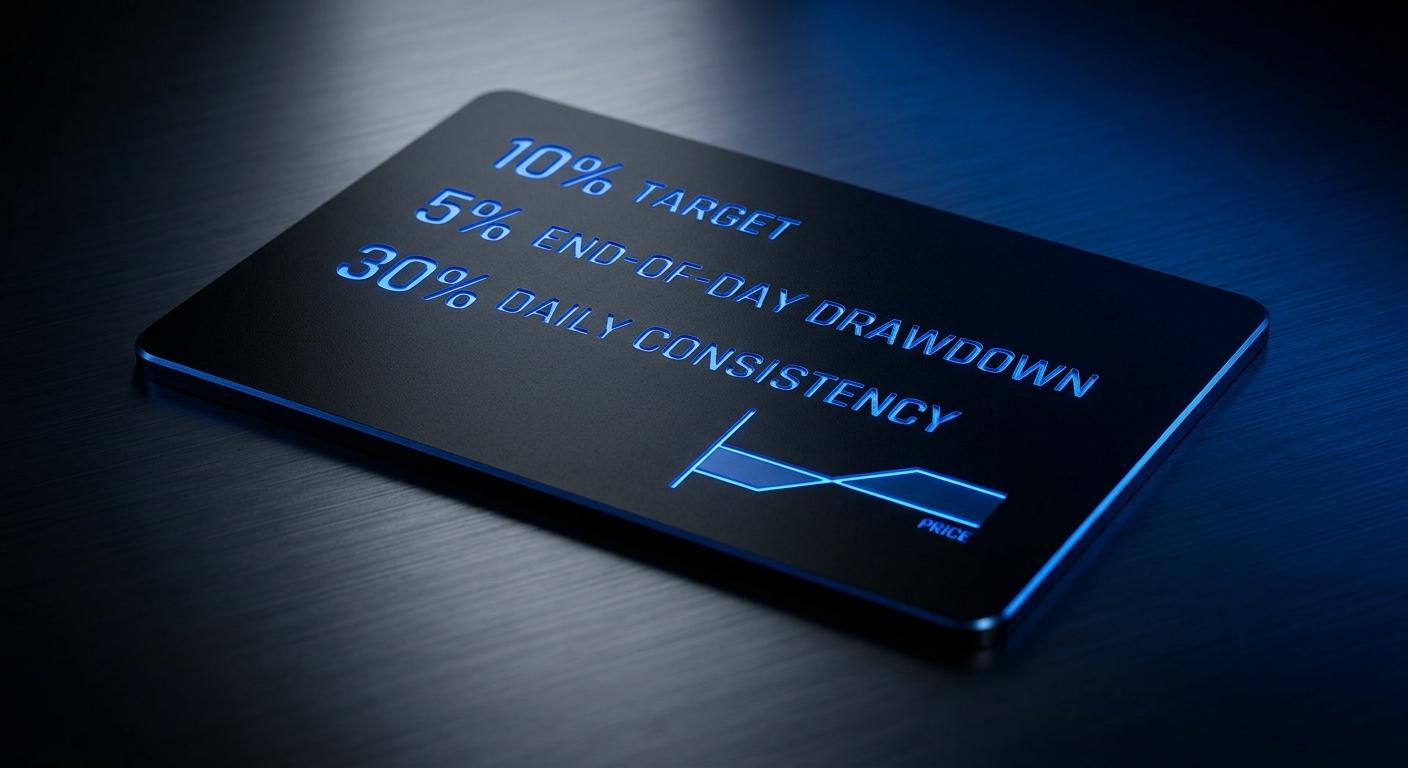
The rest of the plan is set up for that style of trading. Your 5% loss limit moves only after the close, which gives multi-leg positions room to work through the session. The trade-off is a 10% target, a 30% daily consistency rule and a minimum of four trading days. Below, we cover every Advanced Options rule from the Evaluation to your first payout. If you want to see how it stacks up against the other plans first, our Vanquish Trader rules overview compares all four.
Who Advanced Options is for
This plan is for traders whose edge comes from structure, not just direction. If you sell put credit spreads on NVDA after a pullback, run iron condors on SPY in quiet weeks, or collect premium on QQQ, you need permission to sell to open, and Advanced Options is the plan that gives it to you.
It also suits traders who grind out steady daily gains. Premium-selling tends to produce lots of modest days rather than one huge one, which is exactly what the daily consistency rule rewards.
If you only buy calls and puts, you don’t need Level 4. Basic Options has the same 10% target and 5% drawdown at a lower price, with an intraday trailing limit instead of end of day.
Advanced Options pricing and account sizes
Advanced Options is billed monthly, from $199 for a $10,000 account to $1,499 for $150,000. The fee applies to both the Evaluation and the Performance Account for as long as the account is active.
Account size | Monthly price | Reset cost | Profit target (10%) | Loss limit (5%) |
|---|---|---|---|---|
$10,000 | $199 | $99 | $1,000 | $500 |
$50,000 | $499 | $249 | $5,000 | $2,500 |
$75,000 | $799 | $399 | $7,500 | $3,750 |
$100,000 | $999 | $499 | $10,000 | $5,000 |
$150,000 | $1,499 | $749 | $15,000 | $7,500 |
If you breach, you can reset right away for the cost above rather than waiting for your next billing date. There’s no time limit on the Evaluation.
Advanced Options Evaluation rules
To pass, you need a 10% profit on closed trades over at least four trading days, with your best day under 30% of your total profit, and your equity never touching the loss limit. There’s no daily loss limit and no deadline.
Profit target: 10%
Your target is 10% of your starting balance, which is $1,000 on a $10,000 account and $15,000 on $150,000. Only closed trades count. A credit spread that’s showing most of its max profit still has to be closed before that profit counts toward the target.
Maximum drawdown: 5%
Your maximum drawdown is 5% of your starting balance: $500 on a $10,000 account, up to $7,500 on $150,000. It’s the distance between your loss limit and your highest end-of-day equity.
How the end-of-day drawdown works
Your loss limit moves up once a day, after the close, based on where your equity finished. Intraday highs don’t move it, and it never moves down. The limit is still enforced in real time, though. If your equity, open positions included, touches it at any moment, the account is breached.
Here’s a $10,000 account over three days:
Day | What happens | End-of-day equity | Loss limit after close |
|---|---|---|---|
Start | Account opens | $10,000 | $9,500 |
1 | A put spread on MU works, equity touches $10,450, and you finish at $10,300 | $10,300 | $9,800 |
2 | A small losing day | $10,150 | $9,800 |
3 | An open iron condor gets tested and equity drops to $9,800 | n/a | Breached |
The day 1 close sets the limit, not the $10,450 high. That’s the point of end of day: a spread that runs in your favor midday and gives some back before the close doesn’t ratchet your limit up on the way. Our guide to trailing drawdown explains how this compares with intraday and static models.
The daily consistency rule: 30%
Your best day must be less than 30% of your total profit. A day’s result is the net of everything you closed that day, and losing days reduce your total. If you’re at 30% or more, the account isn’t breached. You simply keep trading until it drops.
On a $10,000 Evaluation, imagine four days of $200, $450, $250 and $150. That’s $1,050, past the target, but your $450 day is 42.9% of it. To get under 30%, your total needs to beat $1,500, which is your best day divided by 0.3. A few more steady days get you there.
Advanced Options measures consistency by day, like Rapid Elite, while Basic Options measures it by trade. Our consistency rule explainer compares all three approaches, and the Advanced Options section of our Help Center has extra worked examples.
Minimum of four trading days
You need at least four trading days to pass. You don’t have to finish in four, and in practice the consistency rule points the same way: with three days or fewer, your best day is always at least a third of your total.
Other Evaluation rules
- No daily loss limit. Only your loss limit applies.
- No time limit. Take as long as you need.
- No overnight positions. Every position, spreads included, must be closed by 3:59 p.m. ET or it’s closed automatically at market.
- No margin.
- No withdrawals. Evaluation profit can’t be paid out. Payouts come from your Performance Account.
Advanced Options Performance Account rules
Once you pass, there’s no profit target. Your loss limit keeps trailing your end-of-day equity until you reach the Buffer, and the daily consistency rule and four-day minimum stay in place as conditions for each payout. If this is your first funded account, here’s how the two account stages differ.
The Buffer
The Buffer sits 5.75% above your starting equity, and Advanced Options checks it at the close. When a day finishes at or above it, your loss limit locks permanently at 0.75% above your starting equity.
Account size | Buffer | Locked loss limit |
|---|---|---|
$10,000 | $10,575 | $10,075 |
$50,000 | $52,875 | $50,375 |
$75,000 | $79,312.50 | $75,562.50 |
$100,000 | $105,750 | $100,750 |
$150,000 | $158,625 | $151,125 |
Only the closing number counts. A $10,000 account that trades up to $10,700 but finishes at $10,500 hasn’t reached the Buffer. Close at $10,600 the next day and the limit locks at $10,075. After that it stays put for the life of the account, through new highs and withdrawals alike. Our guide to how the Buffer works compares it across every plan.
Advanced Options payouts
To request a payout, you need at least $250 in profit, daily consistency below 30% and at least four trading days since your last payout. You don’t need to reach the Buffer first. You keep 100% of what you withdraw.
Both consistency and your trading-day count reset after every payout. In practice, that means you can request a payout at most once every four trading days, and each cycle needs its own run of steady days. Only one request is allowed per day across all your accounts.
Reaching the Buffer before you withdraw is the safer route, because a payout lowers your equity while your loss limit stays where it is. With a $10,000 account at $10,800 and the limit locked at $10,075, a $700 withdrawal leaves just $25 of room. That’s a thin margin for an open iron condor. Our payout rules page walks through how this works on every plan.
What you can trade on Advanced Options
Advanced Options unlocks Level 4 options on every ticker except three. The same permissions apply in the Evaluation and on the Performance Account.
Strategy | Allowed? |
|---|---|
Buying calls and puts | Yes |
Selling to open | Yes |
Vertical spreads, debit and credit | Yes |
Iron condors, butterflies, straddles and strangles | Yes |
Selling puts | Yes, cash-secured only |
Covered calls | Yes |
Buying shares on their own | No, only as part of a covered call |
Margin | No |
Contract or position size limits | None |
That covers most of what premium sellers reach for, from short puts on a stock you wouldn’t mind owning to iron condors on QQQ in a range-bound week. Cash-secured means you need enough cash in the account to buy the shares if the put is assigned.
The one restriction is on SPX, XSP and VIX. On those three, you can only buy single-leg calls or puts. Spreads of any kind, including defined-risk credit spreads, and selling to open aren’t allowed there. Every other underlying is open to the full range of strategies.
Every position has to be closed by 3:59 p.m. ET, whatever the strategy or expiration. Anything still open is closed automatically at market, and on a four-leg position that fill can be noticeably worse than closing it yourself a few minutes earlier. You trade on DxTrade, on the web, iOS or Android.
Advanced Options rules FAQ
Can I trade credit spreads on SPX?
No. On SPX, XSP and VIX, you can only buy single-leg calls or puts. Credit spreads, iron condors and other multi-leg strategies are allowed on every other ticker, including SPY and QQQ.
Can I sell naked calls or puts?
You can sell to open, but puts must be cash-secured and margin isn’t available. Calls can be sold as part of a spread or against shares in a covered call.
How many days does it take to pass Advanced Options?
At least four trading days. The 30% daily consistency rule points the same way, because with three days or fewer, your best day is always at least a third of your total.
Is the Advanced Options drawdown trailing or static?
It trails at the end of each day. Your loss limit moves up after the close based on your end-of-day equity, and on a Performance Account it locks once you close at or above the Buffer.
How often can I get paid on Advanced Options?
At most once every four trading days. Consistency and your trading-day count reset after each payout, and you need $250 in profit, consistency below 30% and four trading days each time.
Can I hold an iron condor overnight?
No. All positions, including multi-leg ones, must be closed by 3:59 p.m. ET. That makes 0DTE and same-day setups the natural fit.
Do I keep paying after I pass?
Yes. The monthly fee continues on the Performance Account for as long as it’s active.
Compare with other plans
- Basic Options plan rules: same 10% target and 5% drawdown, long calls and puts only, intraday trailing
- Rapid Express plan rules: 9% target, 3% intraday trailing drawdown, no consistency rule
- Rapid Elite plan rules: 9% target, 3% end-of-day drawdown, 50% daily consistency
Ready to start? Pick your account size on the plans page.