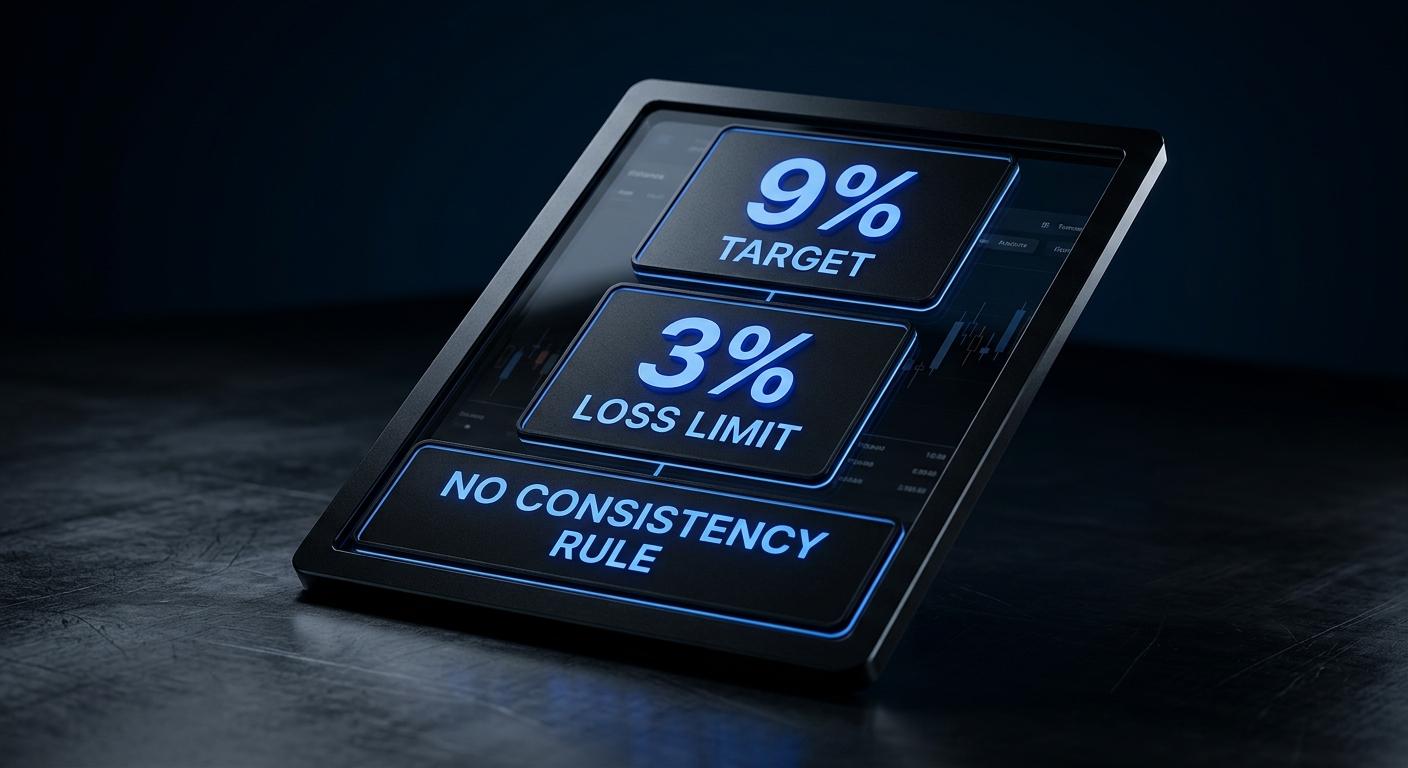
Basic Options gives you more room than either Rapid plan. Your loss limit is 5% of your starting balance, compared with 3% on the Rapid plans, so a position that moves against you before it works out has a better chance of surviving.
The extra room comes with a higher bar. The profit target is 10%, you need at least 10 trades, and no single trade can make up 30% or more of your total profit. This page covers each of those rules, how the Performance Account works once you pass, and how payouts are handled.
For a quick comparison with the other three plans, our Vanquish Trader rules overview lays them out side by side.
Who Basic Options is for
Basic Options fits traders who take a steady stream of similar-sized trades. If you’re working a few setups a week on names like CRWD, UBER or SOFI, and no one trade usually dominates your P&L, the consistency rule will rarely get in your way.
It’s also a good match for anyone who wants daily payouts without having to wait out a minimum number of days between requests.
It’s less suited to traders who rely on one big swing to make their month. If that sounds like you, Rapid Express has no consistency rule at all, although its drawdown is tighter.
Basic Options pricing and account sizes
Basic Options is billed monthly, from $99 for a $10,000 account to $750 for $150,000. The fee covers both the Evaluation and the Performance Account for as long as the account is active.
Account size | Monthly price | Reset cost | Profit target (10%) | Loss limit (5%) |
|---|---|---|---|---|
$10,000 | $99 | $49 | $1,000 | $500 |
$50,000 | $250 | $125 | $5,000 | $2,500 |
$75,000 | $375 | $187 | $7,500 | $3,750 |
$100,000 | $500 | $250 | $10,000 | $5,000 |
$150,000 | $750 | $375 | $15,000 | $7,500 |
If you breach, you can reset straight away for the cost above instead of waiting for your next billing date. There’s no time limit on the Evaluation, so you can pass at your own pace.
Basic Options Evaluation rules
To pass, you need three things at the same time: a 10% profit on closed trades, at least 10 trades, and consistency below 30%. Your equity also has to stay above your loss limit throughout. There’s no daily loss limit and no deadline.
Profit target: 10%
Your target is 10% of your starting balance. On a $10,000 account, that means growing it to $11,000. On $150,000, you need $15,000 in profit. Only closed trades count, so a position that’s showing enough profit to pass hasn’t passed you until you sell it.
Maximum drawdown: 5%
Your maximum drawdown is 5% of your starting balance, or $500 on a $10,000 account. It’s measured from your highest equity, not from where you started, so the gap stays the same as your account grows.
How the intraday trailing drawdown works
Your loss limit is your equity peak minus your maximum drawdown. It updates in real time, includes open trades, and only ever moves up.
Take a $10,000 account. Your loss limit starts at $9,500. You buy META calls ahead of a product event, and your equity touches $10,600 while the trade is open. Your loss limit is now $10,100. The calls give some back, and you sell at $10,300. You’ve made $300, but your room has shrunk from $500 to $200, because the limit followed the peak.
This is why many Basic Options traders take partial profits into strength rather than waiting for a trade to reverse. Our guide to trailing drawdown compares this approach with end-of-day and static drawdowns.
The consistency rule: 30% per trade
Your best trade has to be less than 30% of your total profit. Losing trades reduce your total, so they push your consistency up. If you’re over 30%, the account isn’t breached. You keep trading until it comes down.
Say you’ve made $1,050 across 11 trades on a $10,000 Evaluation, and your best was a $350 QQQ put. That’s 33.3%, so you haven’t passed yet, even though you’re over the target. Two more winners of $75 each bring your total to $1,200, your consistency to 29.2%, and you’re through.
A quick check: divide your best trade by 0.3 to find the total you need to beat. Adding contracts to an open position doesn’t create a new trade, so scaling into a winner keeps all of its profit in one trade. Basic Options measures consistency per trade, while Rapid Elite and Advanced Options measure it per day. Our consistency rule explainer covers the differences, and the Basic Options section of our Help Center has more worked examples.
Minimum of 10 trades
You need at least 10 trades to pass. They don’t all need to be winners, and you don’t have to pass within 10. The minimum only applies to the Evaluation.
Other Evaluation rules
- No daily loss limit. Only your trailing loss limit applies.
- No time limit. Pass at your own pace.
- No overnight positions. Close everything by 3:59 p.m. ET, or it’s closed automatically at market.
- No withdrawals. Evaluation profit can’t be paid out. Payouts come from your Performance Account.
Basic Options Performance Account rules
Once you pass, the profit target and the 10-trade minimum fall away. Your loss limit keeps trailing in real time until you reach the Buffer, and the 30% consistency rule stays, now as a condition for each payout. If you’re making the jump from Evaluation to funded for the first time, here’s how the two account stages differ.
The Buffer
The Buffer sits 5.75% above your starting equity. Basic Options checks it in real time, so profit on an open trade counts. The moment your equity reaches it, your loss limit locks permanently at 0.75% above your starting equity.
Account size | Buffer | Locked loss limit |
|---|---|---|
$10,000 | $10,575 | $10,075 |
$50,000 | $52,875 | $50,375 |
$75,000 | $79,312.50 | $75,562.50 |
$100,000 | $105,750 | $100,750 |
$150,000 | $158,625 | $151,125 |
From then on, the limit doesn’t move. It won’t climb as you add to your gains, and it won’t drop when you take money out. Because the 5% drawdown is wider than on the Rapid plans, the locked limit lands closer to your starting balance. That works out to $10,075 on a $10,000 account, compared with $10,275 on Rapid Express or Rapid Elite. Our guide to how the Buffer works compares every plan.
Basic Options payouts
You can request a payout once you have at least $250 to withdraw and your consistency is below 30%. You don’t need to reach the Buffer first, and there’s no minimum number of trades on the Performance Account. Payouts can be requested daily, with one request per day across all your accounts. You keep 100% of your profits.
Unlike Rapid Elite, consistency on Basic Options doesn’t reset after a payout. It’s based on your full trade history, so a strong run of steady trades keeps you eligible from one day to the next.
Plan your withdrawals around your loss limit, because a payout lowers your equity but leaves the limit where it is. If your $10,000 account sits at $10,800 with the limit locked at $10,075, withdrawing $700 leaves you $25 of room. Take the full $800 and you’ll be paid, but the account is breached. Our payout rules page explains how this works on all four plans.
What you can trade on Basic Options
Basic Options allows long calls and long puts on any ticker. That means single-stock options on names like TSLA or RKLB, as well as index and ETF options such as SPY and QQQ. Every position is a single-leg buy that you sell to close, and everything has to be flat by 3:59 p.m. ET.
Spreads, multi-leg strategies and selling to open and margin aren’t available. If those are central to how you trade, Advanced Options allows Level 4 options. You trade on DxTrade, from the web, iOS or Android.
Basic Options rules FAQ
What is the Basic Options consistency rule?
Your best single trade must be less than 30% of your total profit. It applies when you pass the Evaluation and whenever you request a payout. Going over it doesn’t breach your account; you just keep trading.
Does adding contracts count as a new trade?
No. Adding to or trimming the same position counts as one trade, so all of its profit goes toward that trade when consistency is calculated.
Do I need 10 winning trades?
No. You need at least 10 trades in total, winners or losers, and you don’t have to pass within 10.
Is the Basic Options drawdown trailing or static?
It trails intraday. Your loss limit is your equity peak minus 5%, updated in real time including open trades. On a Performance Account, it locks once you reach the Buffer.
How often can I request a payout?
Daily, once you have $250 to withdraw and your consistency is below 30%. Only one request is allowed per day across all your accounts.
Does my consistency reset after a payout?
No. On Basic Options, consistency carries forward across your full trade history.
Do I keep paying after I pass?
Yes. The monthly fee continues on the Performance Account for as long as it’s active.
Compare with other plans
- Rapid Express plan rules: 9% target, 3% intraday trailing drawdown, no consistency rule
- Rapid Elite plan rules: 9% target, 3% end-of-day drawdown, 50% daily consistency
- Advanced Options plan rules: Level 4 options, including spreads and selling to open
Ready to start? Pick your account size on the plans page.