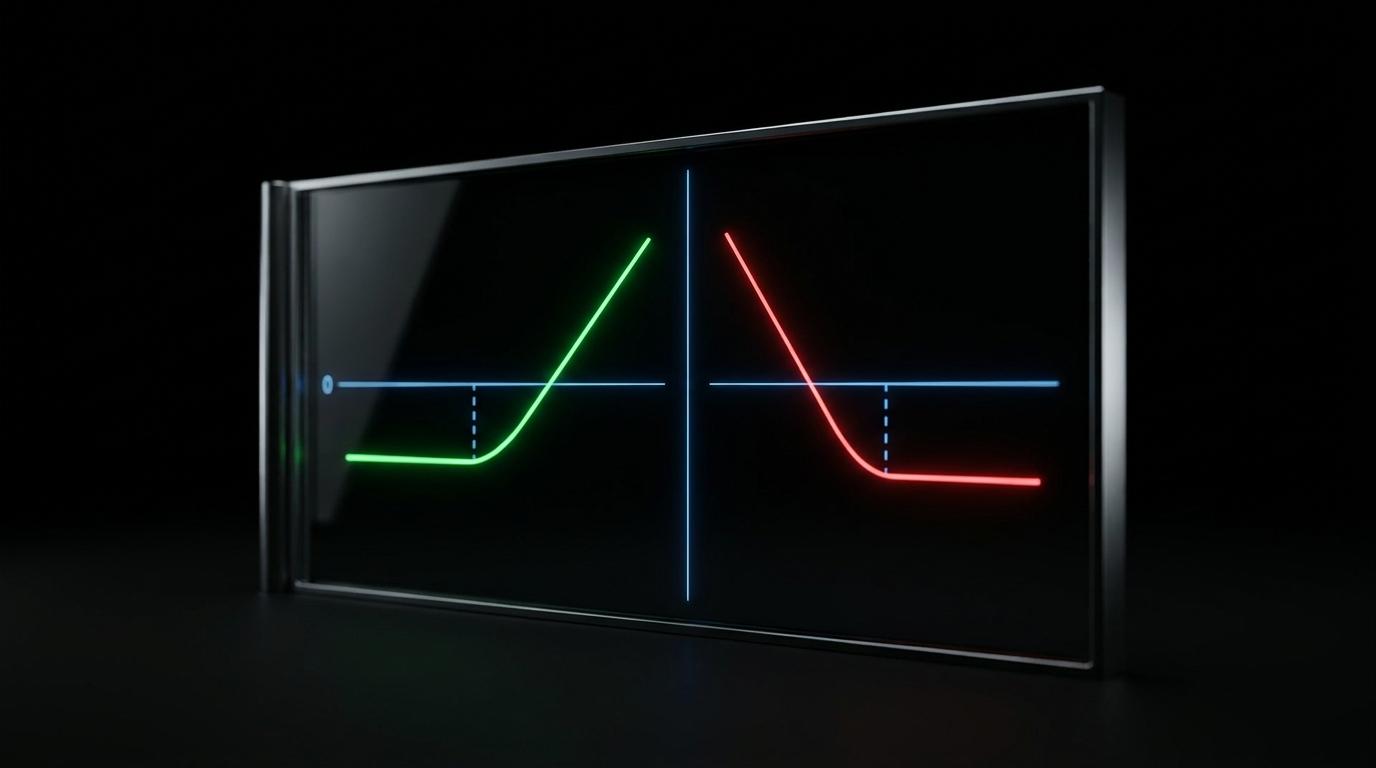
Pull up any option quote and you're looking at two numbers glued together. A NVDA 180 call with the stock at $185 might be trading at $9.20. Five of those dollars are real, bankable value — the stock is $5 above the strike. The other $4.20 is extrinsic value: what buyers are paying for the time and uncertainty left before expiration. Learn to split a premium into those two pieces and option prices stop looking arbitrary.
That split is one of the first things worth understanding once you've got the basics of how contracts work, because it explains why an option can lose money while the stock does exactly what you predicted. If calls and puts are still new territory, the beginner's walkthrough of how options work covers the mechanics this article builds on.
Intrinsic value: the part that's already there
Intrinsic value is the amount an option is in the money. It's the value you'd capture if the contract expired right now, and it can never be less than zero.
- Call: underlying price − strike price (floor of zero)
- Put: strike price − underlying price (floor of zero)
Those figures are per share, so multiply by 100 for a standard contract. With AMZN at $242, the 230 call has $12 of intrinsic value, or $1,200 per contract. The 250 call has none, because exercising the right to buy at $250 when the stock trades at $242 makes no sense.
Three quick labels follow from this. An option with intrinsic value is in the money. One with the strike sitting right at the underlying price is at the money. One with no intrinsic value is out of the money, and whatever it costs is pure extrinsic value. Picking where to sit on that scale is really a decision about how much of your premium you want to be intrinsic — the strike price guide works through that trade-off.
Extrinsic value: everything else in the premium
Subtract intrinsic value from the premium and what's left is extrinsic value, also called time value. It's the market's price for the possibility that the option becomes more valuable before expiration. The Options Industry Council describes it the same way in its breakdown of options pricing: any premium above intrinsic value, reflecting what someone will pay for the chance that the underlying moves their way.
"Time value" is a slightly misleading nickname, because time is only one input. Extrinsic value is built from:
- Time to expiration. More days means more chances for the underlying to move.
- Implied volatility. The bigger the expected swing, the more a contract is worth. Implied volatility is usually the input that moves extrinsic value fastest.
- Moneyness. Extrinsic value peaks at the money and tapers off in both directions.
- Interest rates and dividends. Minor for most trades, but they nudge call and put pricing in opposite directions.
Splitting real premiums
Here's the arithmetic on four different contracts.
Contract | Underlying | Premium | Intrinsic | Extrinsic |
|---|---|---|---|---|
MSFT 500 call | $512 | $18.40 | $12.00 | $6.40 |
MSFT 540 call | $512 | $4.10 | $0.00 | $4.10 |
COIN 300 put | $284 | $21.75 | $16.00 | $5.75 |
QQQ 600 call | $600 | $7.30 | $0.00 | $7.30 |
Two things stand out. The at-the-money QQQ call is 100% extrinsic value, which is also true of every out-of-the-money contract you'll ever buy. And the in-the-money MSFT call carries more extrinsic value in dollar terms than you might expect, but far less as a share of its price — $6.40 out of $18.40, versus the whole premium on the 540 strike.
Deep in-the-money options behave almost like the stock itself. A 0.95 delta call has barely any extrinsic value left to lose, which is why traders who want stock-like exposure with a defined cost reach for them.
Extrinsic value decays, intrinsic value doesn't
Intrinsic value only changes when the underlying moves. Extrinsic value drains away on its own, every day, whether the market is open or not. That bleed is theta, and it's the single most important fact about the options Greeks for anyone buying premium.
The decay isn't linear. An at-the-money option loses extrinsic value slowly with 60 days to run and then falls off a cliff in the last two weeks. By the closing bell on expiration day, extrinsic value is zero and the option is worth exactly its intrinsic value — nothing more. That's the whole reason 0DTE options move the way they do: with hours left, there's almost no time value to cushion the price, so the contract tracks intrinsic value in near-real time.
Volatility collapse does the same job faster. When a company reports earnings and implied volatility resets lower overnight, extrinsic value evaporates in a single print. Traders who've watched a correctly-positioned call lose money after good news have run into IV crush and the extrinsic value it takes with it.
Spotting the split on an options chain
Most chains don't publish an intrinsic value column, so you calculate it in your head: compare the strike to the current underlying price, then subtract from the mid price. Anything left is extrinsic. Doing this across a few strikes shows you instantly where premium is cheap and where you're paying up for hope. Walking the chain this way is a habit worth building, and the step-by-step guide to reading an options chain covers the other columns alongside it.
Liquidity matters here too, because a wide bid-ask spread distorts your estimate of extrinsic value before you've even entered. Strikes with healthy open interest tend to have tighter markets, so the mid price you're measuring against is closer to a price you can actually trade.
What the split means for your trade
Buying an option means buying extrinsic value and watching it melt. You need the underlying to move far enough, fast enough, to convert extrinsic value into intrinsic value faster than theta takes it away. A TSLA call that's 6% out of the money with a week left needs a real move just to break even.
Selling an option flips the equation. A cash secured put or covered call is a bet that extrinsic value will decay faster than the underlying moves against you. The seller's edge is time; the seller's risk is a gap.
That's also why directional traders often shift down the chain. An in-the-money call with $2 of extrinsic value has less to lose to decay than an out-of-the-money call with $2 of extrinsic value and nothing else. You pay more up front, but a far larger share of what you paid is value the market can't simply erode.
LEAPS sit at the other extreme
At the long end, extrinsic value is the dominant component and it barely moves day to day. A contract with eighteen months to expiration loses a trivial amount of time value in any given week, which is why LEAPS options get used as stock substitutes. The flip side: you've paid a large extrinsic premium up front, and if implied volatility contracts across that period, the position can lose value even with the underlying flat.
Short-dated contracts are the mirror image — small extrinsic value, enormous decay rate. Neither is better. They're different ways of paying for the same thing, and knowing the split tells you which one you're actually buying.
Mistakes worth avoiding
- Treating a cheap option as a good deal. A $0.35 contract is 100% extrinsic value with a low probability attached. Cheap and likely are not the same thing.
- Ignoring the decay schedule. Holding an at-the-money option through the final week means accepting the steepest part of the curve.
- Forgetting volatility cuts both ways. Buying when implied volatility is elevated means buying inflated extrinsic value.
- Exercising early for no reason. Exercising throws away any remaining extrinsic value. Selling the contract captures it.
FAQs
Is extrinsic value the same as time value?
In everyday usage, yes. "Time value" is the older term, but extrinsic value is more accurate, because the figure includes implied volatility, interest rates and dividends alongside days to expiration.
Can an option have zero extrinsic value?
At expiration, every option has zero extrinsic value. Before then, deep in-the-money contracts can get very close to zero, and deep in-the-money puts occasionally trade a touch below intrinsic value because of the cost of carrying the position.
How do I calculate extrinsic value?
Take the option's premium and subtract its intrinsic value. For a call with the stock at $94 and a 90 strike trading at $6.50, intrinsic value is $4.00 and extrinsic value is $2.50.
Do out-of-the-money options have any intrinsic value?
No. Out-of-the-money options are entirely extrinsic value, which is also why they can go to zero so quickly. All of their worth depends on a move that hasn't happened yet.
Which has more extrinsic value, a call or a put?
At the same strike and expiration, calls and puts carry similar extrinsic value, with small differences from interest rates and dividends. The bigger driver is moneyness: at-the-money contracts always hold the most.
Once you can look at a quote and immediately say how much of it is intrinsic and how much is extrinsic value, the rest of options pricing gets easier. Position sizing, strike selection and exit timing all run off the same split, which is why it shows up across almost every topic in options trading.
It's worth building that habit early, because the other ideas in the options basics — moneyness, expiration, the Greeks — all end up describing one half of the premium or the other.
If you want to put that into practice on a simulated account with published rules and a 100% profit split, our plans run from $10,000 to $150,000 in account size.