You see a stock you think is going higher, but buying 100 shares ties up thousands of dollars. An options contract lets you control those same 100 shares for a fraction of the cost, with a deadline attached. That trade-off, less money down in exchange for a time limit, is the heart of what are options and why people trade them. The mechanics look intimidating from the outside, but there are only two kinds of contract, two sides to each one, and a handful of terms that define every trade. Our broader walkthrough of how options work for beginners covers the full arc; this page stays on the foundation.
An option is a contract, not a share
When you buy a share of AAPL, you own a slice of the company. When you buy an option, you own an agreement with another trader. That agreement gives you the right, but never the obligation, to buy or sell a specific stock at a specific price until a specific date. The person on the other side took your money and accepted the obligation to honor it.
Two words in that sentence do most of the work. Right means you decide whether to use the contract. Obligation means the seller doesn't get a choice; if you exercise, they have to deliver. That asymmetry is why buyers pay sellers up front, and the payment is called the premium. Everything else in options basics is built on top of that one exchange.
Options are standardized and exchange-listed, which means you're not negotiating terms with a stranger. The Options Clearing Corporation stands between buyer and seller on every trade, and the Options Industry Council's basics FAQ is a useful plain-language reference maintained by the same organization. Standardization is why you can sell a contract you bought ten minutes ago without ever finding the original counterparty.
Calls: the right to buy
A call gives the owner the right to buy the underlying stock at a fixed price. You buy calls when you expect the stock to rise.
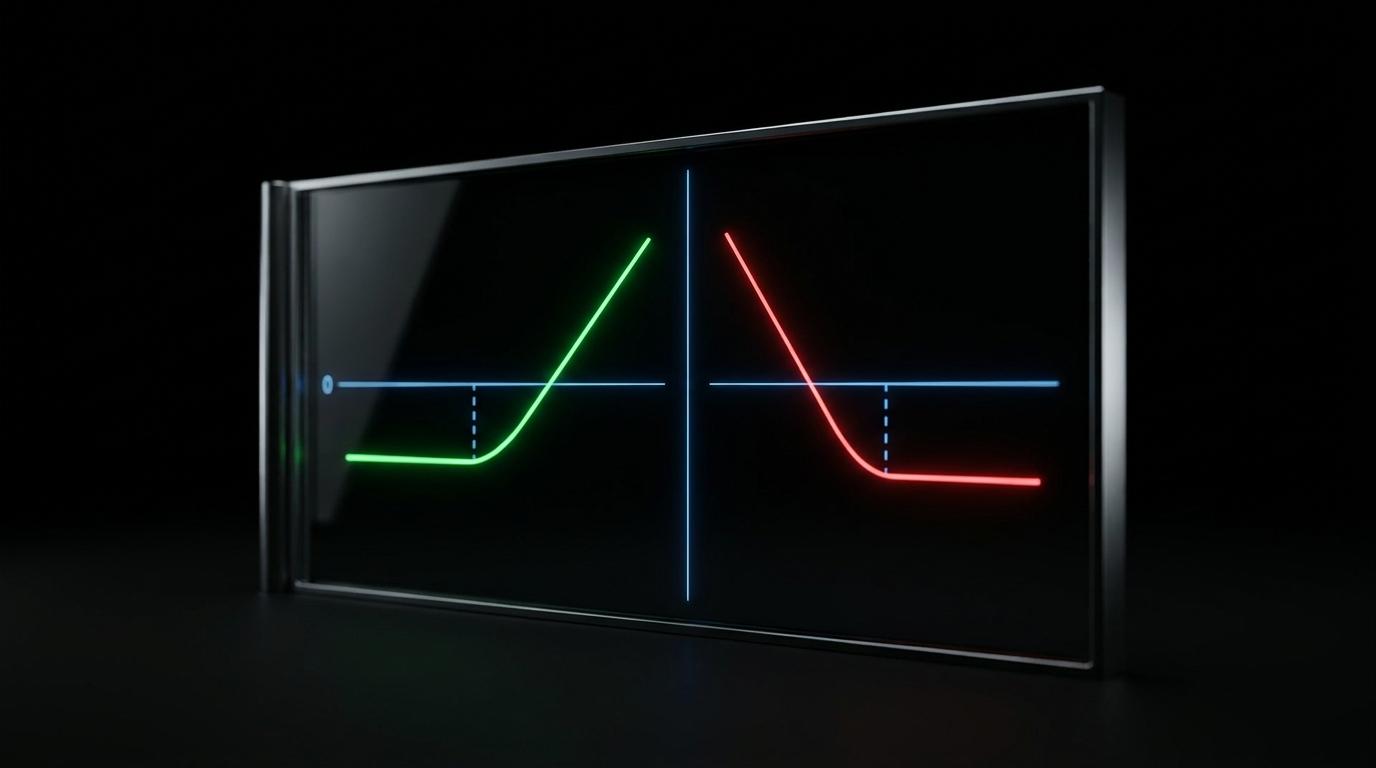
Say NVDA trades at $178 and you buy a call with a $180 strike expiring in six weeks for $6.50 per share. That contract covers 100 shares, so you pay $650. If NVDA runs to $200 before expiration, your right to buy at $180 is worth at least $20 per share, or $2,000 on the contract. If NVDA sits at $175 the whole time, nobody wants the right to pay $180 for it, and the contract expires worthless. Your loss is the $650 you paid, and not a dollar more.
That's the shape of every long call: limited, known risk on the downside, and an upside that keeps running as long as the stock does. The catch is that the stock has to move far enough, fast enough, to cover what you paid.
Puts: the right to sell
A put is the mirror image. It gives the owner the right to sell the underlying stock at a fixed price, so it gains value as the stock falls.
If COIN is trading at $310 and you buy a $300 put for $9, you've paid $900 for the right to sell 100 shares at $300. A drop to $270 makes that right worth $30 per share, or $3,000. A rally to $340 makes it worthless, and again you lose only the premium.
Puts also work as insurance. A trader holding 300 shares of a position can buy three puts below the current price and cap the damage from a bad week, treating the premium as the cost of the policy. The side-by-side breakdown in our call vs put comparison goes deeper on when each one fits.
The terms that define every contract
Every listed option is described by five pieces of information. Quote them in order and you've named the exact contract.
- The underlying — the stock, ETF or index the contract is tied to, such as MSFT, SPY or SPX.
- The type — call or put.
- The strike price — the fixed price at which the contract lets you buy or sell.
- The expiration date — the day the right disappears.
- The premium — what the contract costs right now, quoted per share.
Choosing among them is where new traders spend most of their effort, and the strike price you pick changes the whole character of the trade. A strike close to the current stock price costs more and behaves more like the stock; a far out-of-the-money strike is cheap but needs a big move to pay off.
The multiplier catches people out constantly. A quote of $2.40 doesn't mean the contract costs $2.40, because standard US equity options cover 100 shares per contract. Multiply the quoted premium by 100 and you have your actual cash outlay: $240.
Expiration ranges from same-day contracts on heavily traded names to options a year or more out. Shorter contracts are cheaper and decay faster. Longer contracts cost more and give the thesis time to work.
Where the premium actually comes from
An option's price has two components, and separating them explains a lot of confusing behavior.
Intrinsic value is the part that's already real. A $150 call on a stock trading at $162 has $12 of intrinsic value, because exercising right now would be worth $12 per share. If the stock were at $145, intrinsic value would be zero. It never goes negative.
Extrinsic value is everything else you're paying for: the time left, and how much the market expects the stock to move. Our explainer on intrinsic versus extrinsic value walks through the split in detail, but the short version is that extrinsic value shrinks every day and hits zero at expiration. That's why an option can expire worthless even when the stock finished higher than when you bought.
Two forces drive extrinsic value. Time decay works against buyers steadily, accelerating in the final weeks. Implied volatility moves it both ways: when the market expects a big swing, premiums inflate, and when the swing resolves, they deflate fast. Buying expensive options before an earnings release and watching them lose value on a correct directional call is one of the most common early mistakes.
Reading a quote screen
Prices live on the options chain, a grid showing every strike and expiration for a ticker with bids, asks and volume. Learning to read an options chain is the practical skill that turns the theory above into an actual order ticket, since the chain is where you compare what each strike costs against what it needs the stock to do.
Two columns sit next to each other and get mixed up constantly. Volume counts contracts traded today. Open interest tracks contracts still outstanding from all previous sessions. Low numbers in both usually mean a wide bid-ask spread, which quietly taxes you on entry and exit. Sticking to liquid names like SPY, QQQ or the large caps keeps that cost small while you're learning.
Four positions, two of them for later
Each contract type has a buyer and a seller, so there are four basic positions:
Position | You expect | Your risk |
|---|---|---|
Long call | Stock rises | Limited to premium paid |
Long put | Stock falls | Limited to premium paid |
Short call | Stock stays flat or falls | Large, unlimited if uncovered |
Short put | Stock stays flat or rises | Large, down to zero on the stock |
Buying is where almost everyone starts, and for good reason: your worst case is written on the ticket before you click. Selling collects premium up front and wins more often, but the losses when they come are bigger than the credits, which is why brokers gate it behind higher approval levels and why covered or cash-secured versions exist.
Why traders bother
A few reasons come up again and again.
- Defined risk. A long call or put can't lose more than it cost, which makes position sizing arithmetic rather than guesswork.
- Capital efficiency. Controlling 100 shares of a $400 stock through a contract costs a fraction of the $40,000 the shares would.
- Hedging. Puts offset downside in a portfolio without selling anything.
- Income. Selling options against shares or cash turns sideways markets into cash flow.
- Precision. You can express a view on direction, timing and magnitude all at once, instead of just direction.
Those advantages come packaged with a real cost: options expire. A stock position can be wrong for two years and still come good. An option that's wrong for six weeks is simply gone. Everything else in options trading is a variation on managing that clock.
FAQs
What are options in simple terms?
An option is a contract that gives you the right, but not the obligation, to buy or sell 100 shares of a stock at a set price before a set date. Calls give you the right to buy; puts give you the right to sell. You pay a premium for that right, and the premium is the most a buyer can lose.
What is the difference between a call and a put?
A call profits when the underlying rises above the strike, because you hold the right to buy cheaply. A put profits when the underlying falls below the strike, because you hold the right to sell high. Buyers of both have risk limited to what they paid.
How much does one options contract cost?
Multiply the quoted premium by 100. A contract quoted at $1.75 costs $175, plus commissions. Premiums range from a few cents for far out-of-the-money strikes to many dollars for in-the-money or long-dated contracts.
Can you lose more than you paid for an option?
Not as a buyer. The premium is your maximum loss on a long call or long put. Sellers are different: a short put can lose most of the strike value if the stock collapses, and an uncovered short call has theoretically unlimited risk.
Do you have to exercise an option to make money?
No, and most traders never do. Contracts are bought and sold on the exchange like any other instrument, so you close a profitable position by selling it rather than exercising. Exercise mainly matters at expiration, when in-the-money equity options are automatically exercised and index options such as SPX settle in cash.
Are options only for experienced traders?
Buying calls and puts is accessible at the first level of options approval and is where most people begin. Spreads, selling to open and multi-leg structures require higher approval, more capital and a firmer grip on how premium behaves.
Strip away the jargon and the answer to what are options is short: a contract, a price, a deadline. Calls bet on a rise, puts bet on a fall, and the premium you pay is the price of being able to be wrong without losing everything. Practice reading chains and sizing positions before you push real size through, then decide where you want that practice to lead. If it's toward trading a funded options account on rules you can read up front, our plans lay out exactly what each one asks of you.