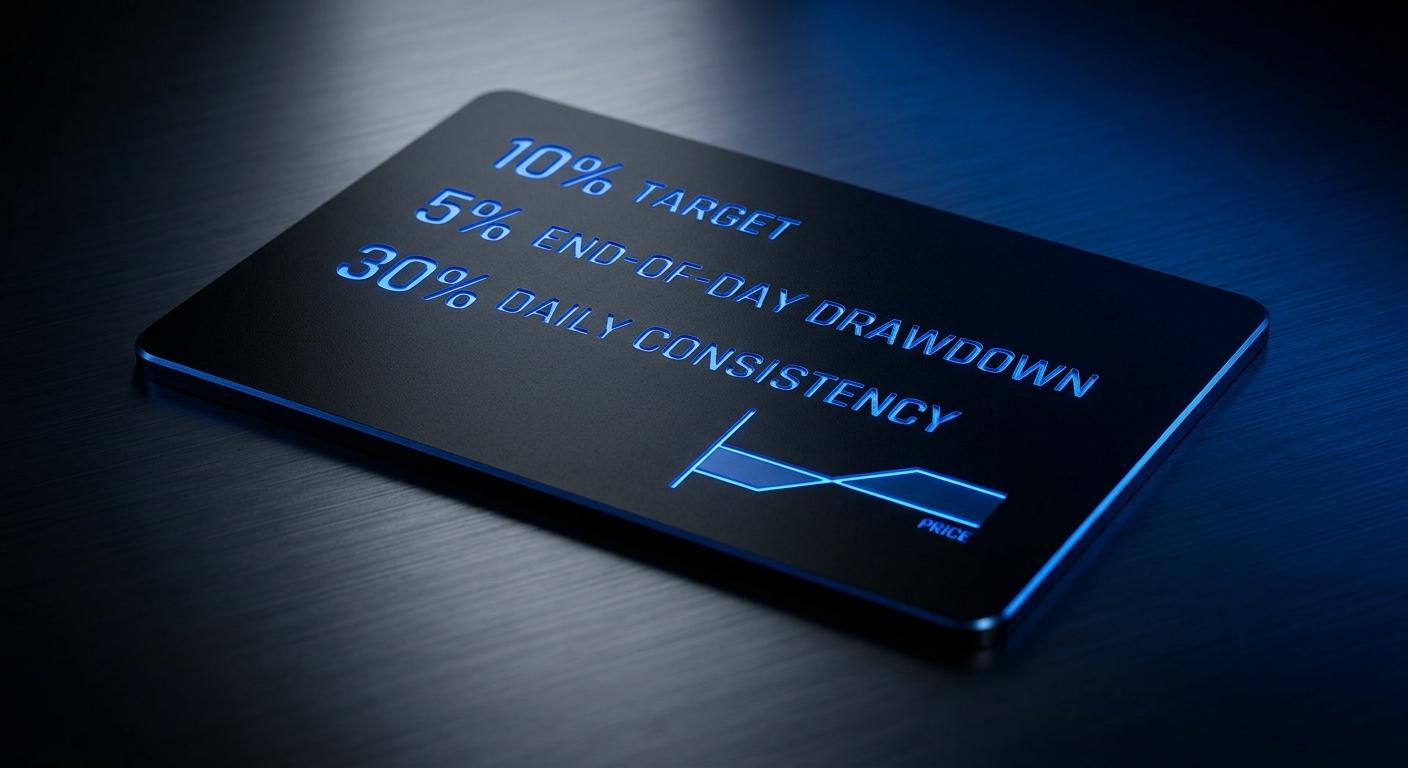
Four plans, four sets of rules, and no single best option. The right Vanquish plan is the one whose rules fit the way you already trade, so you’re not changing your strategy just to pass.
This guide skips the full rulebook (our Vanquish Trader rules page covers every rule side by side) and focuses on the decision. It starts with a quick answer, then works through the questions that actually separate the plans.
The quick answer
If you… | Choose |
|---|---|
Want to pass as fast as possible, with no consistency rule | Rapid Express |
Buy calls and puts but need room for trades to swing during the day | Rapid Elite |
Buy calls and puts and want the widest loss limit and daily payouts | Basic Options |
Trade spreads, iron condors or sell premium | Advanced Options |
If one of those rows describes you, you probably have your answer. If two or three sound right, the sections below will help you choose.
Five questions that decide it
1. Do you need spreads or to sell options?
This is the first fork, because it rules plans in or out completely. If your strategy uses vertical spreads, iron condors, covered calls or cash-secured puts, Advanced Options is the only plan that allows them.
If you only buy calls and puts, all three of the other plans fit, and they let you trade any ticker, from MSFT and AVGO to SPX and QQQ. The rest of these questions decide between them.
2. Do your profits come in bursts or build steadily?
Think about your last good month. Did one trade or one day do most of the work, or did it come from lots of modest wins? The answer points you at a consistency rule you can live with.
Plan | Consistency rule | Best for |
|---|---|---|
Rapid Express | None | Traders whose results come from a few big winners |
Rapid Elite | Best day below 50% | Traders who spread profit over at least a few days |
Basic Options | Best trade below 30% | Traders who take many evenly sized trades |
Advanced Options | Best day below 30% | Traders who grind out steady daily gains |
If you’re unsure how your own results would score, our guide to the consistency rule shows how to calculate it.
3. How much do your trades swing during the day?
Every plan uses a trailing loss limit, but there are two styles. Intraday trailing (Basic Options and Rapid Express) moves your limit up in real time, open profit included. End-of-day trailing (Advanced Options and Rapid Elite) only moves it after the close.
If you take profit quickly and rarely let a winner give much back, intraday trailing won’t trouble you. If your positions often run, fade and run again before you close them, an end-of-day limit is far more forgiving. Our trailing drawdown guide runs the same two days through both styles.
The size of the limit matters too. Basic Options and Advanced Options give you 5%, while the Rapid plans give you 3% in exchange for a lower 9% target.
4. How often do you want to get paid?
Plan | How often you can request a payout |
|---|---|
Basic Options | Daily |
Rapid Express | Daily |
Rapid Elite | At most every 3 trading days |
Advanced Options | At most every 4 trading days |
Every plan has a $250 minimum, and you keep 100% of your profits. The full payout rules explain what affects eligibility on each plan.
5. What’s your budget?
All four plans are billed monthly and come in sizes from $10,000 to $150,000. On a $10,000 account, Rapid Express is $79 a month, Rapid Elite and Basic Options are $99, and Advanced Options is $199. The fee continues on the Performance Account, so it’s worth weighing against how often you expect to withdraw.
Head to head: the close calls
Rapid Express vs Rapid Elite
These two share a 9% target, a 3% drawdown and long-only permissions. They differ in how they treat your day.
Rapid Express | Rapid Elite | |
|---|---|---|
Drawdown | Intraday trailing | End-of-day trailing |
Consistency rule | None | Best day below 50% |
Fastest pass | One trade, one day | Three trading days |
Payouts | Every 24 hours | At most every 3 trading days |
Price ($10,000) | $79/month | $99/month |
Choose Rapid Express if you want speed and you manage open positions tightly. Choose Rapid Elite if your trades need room to breathe during the session and you’re happy to take a few days to pass.
Basic Options vs Advanced Options
Both have a 10% target and a 5% drawdown. The real question is whether you need Level 4 options.
Basic Options | Advanced Options | |
|---|---|---|
What you can trade | Long calls and puts | Spreads, multi-leg, selling to open |
Drawdown | Intraday trailing | End-of-day trailing |
Consistency rule | Best trade below 30% | Best day below 30% |
Minimum activity | 10 trades | 4 trading days |
Payouts | Daily | At most every 4 trading days |
Price ($10,000) | $99/month | $199/month |
If you only buy options, Basic Options gives you the same target and drawdown for half the price, with faster payouts. Advanced Options earns its price when your edge comes from structure, such as selling premium on SPY in a quiet week or running an iron condor on QQQ.
Basic Options vs Rapid Express
Both trail intraday and allow long calls and puts. Basic Options gives you more room (5% vs 3%) but asks for more: a 10% target, 10 trades and a 30% per-trade consistency rule. Rapid Express trades that room for speed, with a lower 9% target and no consistency rule or trade minimum.
If a tight loss limit makes you nervous, Basic Options is the safer pick. If you trust your sizing and want to get funded quickly, Rapid Express is hard to beat.
Which plan fits your trading style?
The momentum trader → Rapid Express
You buy calls on TSLA when it breaks out, take profit fast, and a couple of big days make your month. A consistency rule would hold you back, and you’re disciplined about exits, so an intraday trailing limit suits you. Rapid Express lets one strong session carry you through.
The intraday swing trader → Rapid Elite
You buy NVDA or ARM calls on a thesis and let them work through the session, accepting some chop on the way. Your limit shouldn’t jump every time a position spikes. Rapid Elite’s end-of-day drawdown gives you that room, and your steadier P&L clears its 50% daily rule without much thought.
The consistent day trader → Basic Options
You take several similar-sized trades a day on QQQ or SOFI, and no single trade ever dominates. You’d like the widest drawdown on offer and the option to withdraw daily. Basic Options matches that style almost exactly.
The premium seller → Advanced Options
You sell put credit spreads on AAPL, run iron condors on QQQ, and write covered calls. Only Advanced Options allows that. Its end-of-day drawdown suits multi-leg positions, and the steady daily income they tend to produce fits its 30% daily consistency rule.
The 0DTE index trader → any long-options plan
If you buy same-day SPX or XSP calls and puts, any of the three long-only plans will work, and your choice comes down to questions 2 to 4 above. One thing to know: even on Advanced Options, SPX, XSP and VIX are limited to buying single-leg calls and puts, so a spread trader on those three would need to use SPY or QQQ instead.
Choosing a plan: FAQ
Which Vanquish plan is easiest to pass?
It depends on how you trade. Rapid Express has the fewest rules and the lowest target, but the tightest, real-time loss limit. Basic Options gives you the most room but asks for 10 trades and steady sizing. The easiest plan is the one whose rules match habits you already have.
Which plan has no consistency rule?
Rapid Express. It has no consistency rule in the Evaluation or on the Performance Account.
Which plan lets me trade spreads?
Only Advanced Options. It allows Level 4 options, including spreads, iron condors, covered calls and cash-secured puts, on every ticker except SPX, XSP and VIX.
Which plan pays out most often?
Basic Options and Rapid Express, where you can request a payout daily. Rapid Elite works out to every three trading days, because its consistency rule resets after each payout, and Advanced Options to every four.
Can I switch plans later?
Each account stays on the plan you bought it on, and a reset restarts you on the same plan and size. Existing accounts can’t be switched, so to trade a different plan, you’ll need to buy a new account on it.
Can I trade single-stock options on every plan?
Yes. All four plans allow options on any ticker. The difference is what you can do with them: buying only on three plans, and Level 4 strategies on Advanced Options.
Still weighing it up? You can compare prices and account sizes for all four on the plans page.