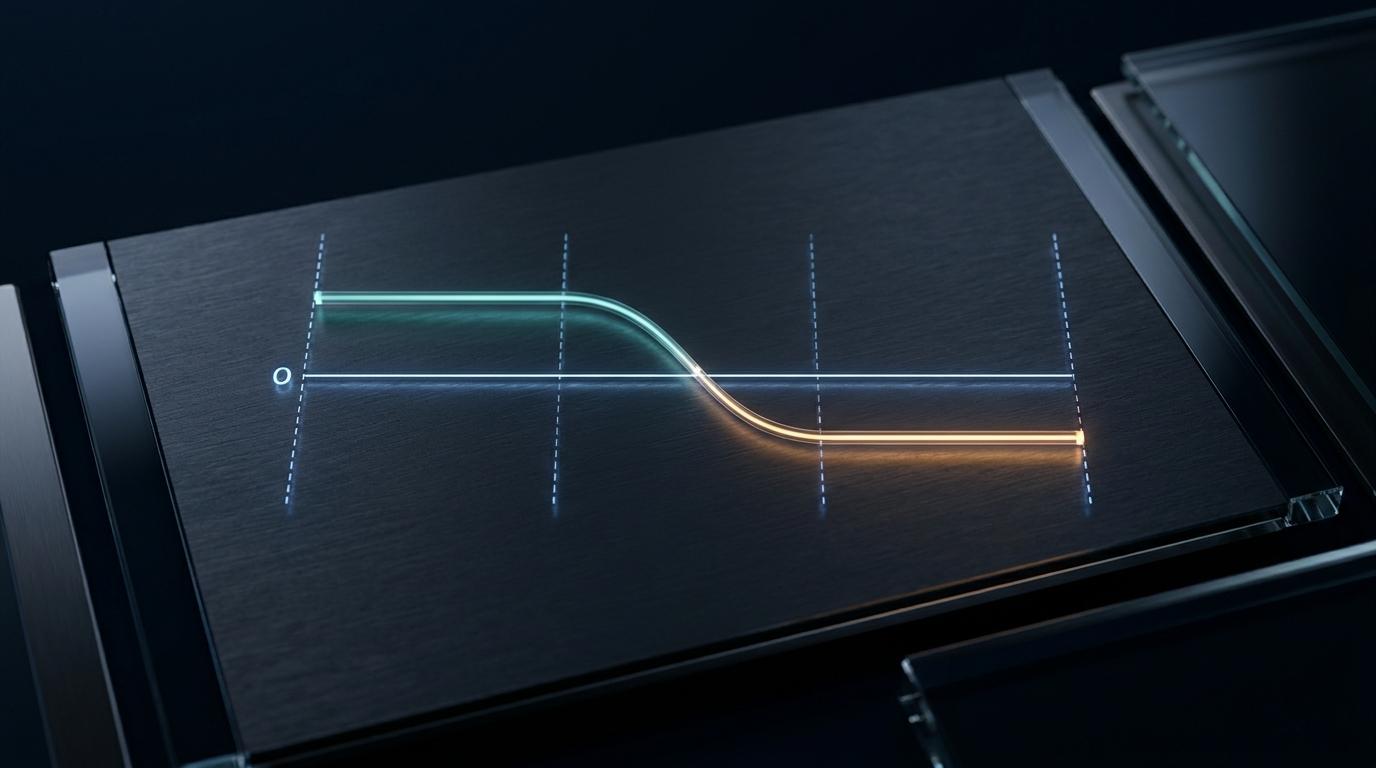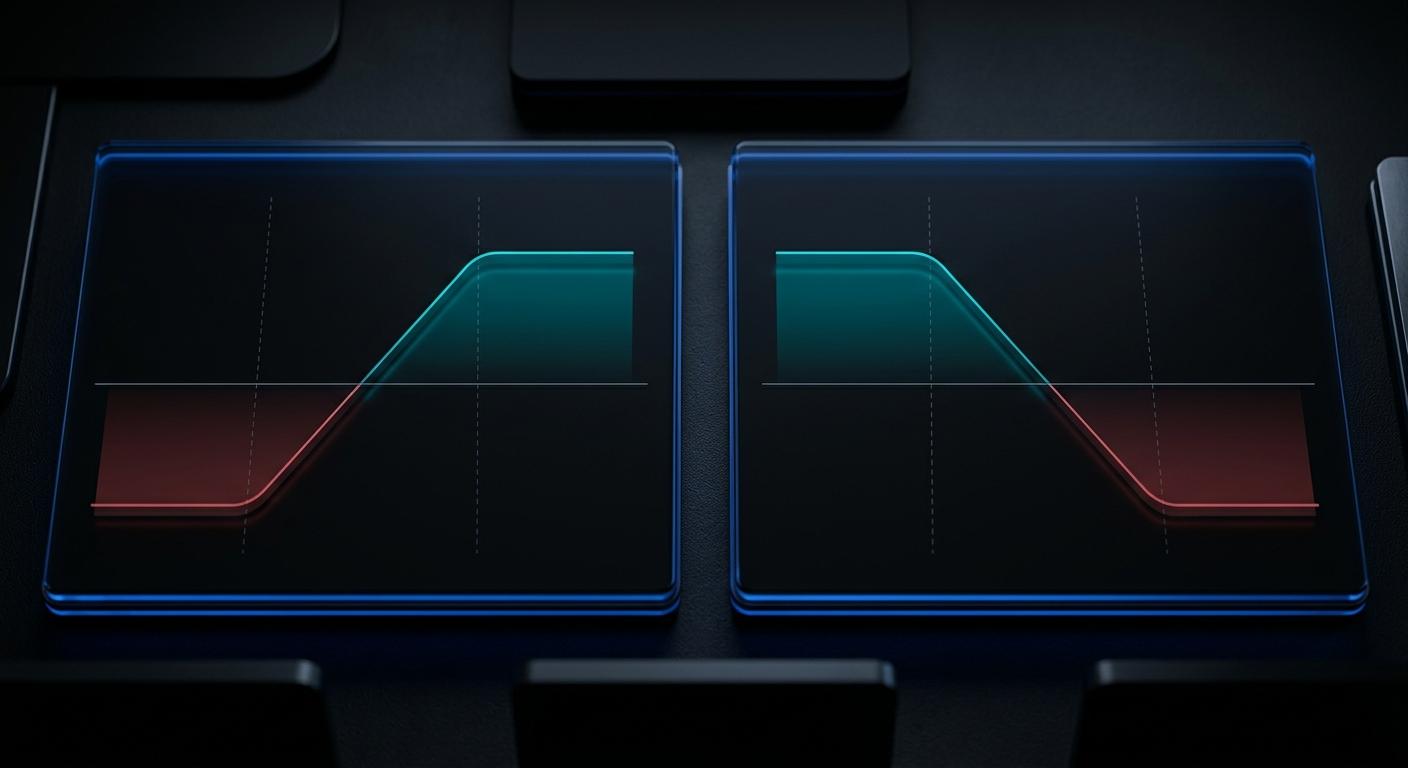
A box spread is the one options position where the profit and loss is known before you place the order. Four legs, two strikes, one expiration, and a payoff at expiration that equals the distance between the strikes no matter where the underlying finishes. That makes it less of a trade and more of a loan dressed up in option contracts.
That fixed payoff is why institutions use boxes to move cash around, and why retail traders who try to copy them sometimes end up with a loss far bigger than anything they could have modeled. The structure itself is simple enough that it belongs in the same mental file as the directional verticals in the full map of options strategies; the danger is entirely in the details of exercise style, execution and margin.
What a box spread actually is
A box spread combines a bull call spread and a bear put spread at the same two strikes and the same expiration:
Leg | Action | Strike |
|---|---|---|
Call | Buy | 6,000 |
Call | Sell | 6,100 |
Put | Buy | 6,100 |
Put | Sell | 6,000 |
The first two legs are a standard bull call spread, which pays off when the underlying rises. The last two are a bear put spread, which pays off when it falls. Put them together and one side always wins exactly as much as the other side loses relative to the strikes, so the combined position stops caring about direction entirely.
The result is a package worth the strike width at expiration. A 100-point box on a $100-multiplier index is worth $10,000 at settlement, full stop. A $5-wide box on a stock is worth $500. Delta, gamma and vega all net out to roughly nothing, and the only variable left is time value of money.
The payoff, checked three ways
Take the 6,000/6,100 box above on a cash-settled index, with one year to expiration. Say you pay a net debit of $9,615 for it. Here's what you collect at settlement:
Settlement | Call spread worth | Put spread worth | Total |
|---|---|---|---|
5,800 | $0 | $10,000 | $10,000 |
6,050 | $5,000 | $5,000 | $10,000 |
6,400 | $10,000 | $0 | $10,000 |
You paid $9,615 and received $10,000 a year later. That's $385 on $9,615, or about 4% — which is not a trading return at all. It's an interest rate. The box priced itself off whatever short-term rate the market was using to discount that future $10,000, and you lent money at that rate using options as the wrapper.
Long box and short box
Everything about a box follows from which side of that loan you're on.
A long box (buy the lower-strike call, sell the higher-strike call, buy the higher-strike put, sell the lower-strike put) costs money today and pays the strike width later. You are the lender. The return is the implied rate, and it will sit somewhere near Treasury yields because market makers arbitrage it there.
A short box reverses every leg. Cash comes in today, and you owe the strike width at expiration. You are the borrower, and the implied rate is your cost of funds. This is the version that gets used as a financing tool: Cboe's own write-up on using long-dated SPX boxes as a borrowing vehicle walks through implied rates that land only slightly above Treasuries, which is why the structure attracts institutions and large accounts rather than day traders.
Working out the implied rate
Divide the strike width by the price you paid, subtract one, then annualize over the days to expiration. A $10,000 box bought for $9,900 with 90 days left returns $100 on $9,900, roughly 1.01% over a quarter, or about 4.1% a year. Short the same box and that 4.1% is what you're paying to borrow. Comparing boxes across expirations is really just comparing points on a yield curve, and the arithmetic has nothing to do with your view on the market.
Where box spreads go wrong
The guaranteed payoff holds only if every leg survives to expiration. Three things break that.
Early assignment on American-style options
Equity and ETF options — AAPL, NVDA, SPY, COIN — are American-style, meaning the person on the other side of your short legs can exercise any time. Assign one of your short options early and your clean four-leg box turns into a stock position plus three stray option legs, usually at the worst moment. On a short box, that stock position arrives with a cash obligation attached, and accounts that couldn't cover it have ended up owing their broker far more than the account held. This is the single most expensive mistake in the strategy, and it's entirely avoidable.
European-style, cash-settled index products don't have this problem. SPX and XSP can only be exercised at expiration and settle in cash, which is why serious box activity concentrates there rather than in single stocks. The exercise-style distinction is one of the few places in options trading where the contract specification matters more than anything on the chart.
Execution costs
Four legs means four bid-ask spreads and, at most brokers, four commissions. If the theoretical edge in a 90-day box is one point and you give up half a point crossing spreads, you've worked hard for nothing. Boxes should be sent as a single complex order with a limit price, never legged in one at a time, and the midpoint you see on a thin strike pair is often fiction.
Margin and buying power
A short box borrows money, so brokers treat it like a borrowing position and hold collateral against it, sometimes more than the naive risk calculation suggests. Many retail platforms won't approve the short side at all, and those that do usually require the highest options approval level. Pin risk at expiration on an American-style box adds another layer, since you can finish the day unsure whether a near-the-money short leg was exercised.
How it compares to other four-leg trades
Line a box up against the other four-leg structures in the strategy library and it looks like one of the family: same leg count, same pair of vertical spreads. The intent is completely different.
An iron condor also uses four legs and two spreads, except its strikes are spread apart and its payoff depends very much on where price lands. It's a volatility trade with real risk in both tails.
An iron butterfly tightens that into a single short strike, trading a bigger credit for a narrower profit zone. Again, the outcome is unknown until expiration, which is the opposite of what a box is designed to do.
Even a butterfly spread, which has a fixed maximum risk, still has a payoff curve with a peak and slopes running away from it. A box has no curve at all — just a flat line sitting at the strike width, identical at every price the underlying could print.
Can you trade a box spread at a prop firm?
Usually not in the pure form, and the reason is worth understanding. A box is a financing trade, not a trading edge, and funded account programs are built around directional and defined-risk positions rather than lending cash. Vanquish's Advanced Options plan supports multi-leg structures such as verticals, condors and butterflies, but SPX, XSP and VIX are restricted to single-leg calls and puts, and the Basic Options and Rapid plans are long calls and puts only. There's no margin on any plan either, which rules out the short side by design.
That's not a loss. The implied return on a box is a few percent a year, while a profit target is measured in weeks. The reason to understand the structure is that it teaches you how put-call parity holds option prices together, which is the same logic that tells you whether a vertical you're about to buy is priced fairly.
FAQs
Is a box spread risk-free?
Only when it's built with European-style, cash-settled options, held to expiration, and executed at a sensible price. With American-style contracts, early assignment can unwind the structure and create a genuine loss. Counterparty risk is minimal because the OCC clears every US listed option, but execution and assignment risk are real.
What is the maximum profit on a long box?
The strike width minus what you paid, received at expiration. A $10,000 box bought for $9,850 makes $150 before costs, and nothing you do with the position after entry changes that number.
Why would anyone short a box spread?
To borrow. The cash arrives immediately and the repayment is fixed at the strike width on expiration day, often at a rate competitive with a margin loan. It's a funding decision, not a market view.
Can you close a box spread early?
Yes, by trading the reverse package, but you'll give up bid-ask on four legs again and the mark before expiration moves with interest rates and any assignment that's already happened. Boxes are usually entered with the intention of holding to settlement.
Treat the box spread as a lesson in how options prices fit together rather than a trade to go hunting for. Once you can see a vertical as half a box, mispriced spreads start standing out, and you stop paying over the odds for the directional structures you actually want to trade. When you're ready to put that reading to work on a funded path, the Vanquish plans lay out which structures each one allows.