You price a 60-day call on NVDA, glance at the put at the same strike, and the two numbers look unrelated. They aren't. Given the stock price, the strike, the time left and interest rates, the call price fixes the put price almost exactly. That fixed relationship is put call parity, and it's the closest thing the options market has to an accounting identity.
Parity isn't a forecasting tool or a strategy. It's a structural rule that holds because, if it ever stopped holding, a trader with capital and low transaction costs could lock in a riskless profit. Understanding it changes how you read an option chain: you stop seeing calls and puts as two separate markets and start seeing them as two views of the same thing. It also explains several results that otherwise look like coincidences, including why a put at a given strike can be worth more than the call, and why certain spreads built from calls and puts have identical payoffs. Pricing models such as Black-Scholes have to respect parity, which is why it sits right alongside the options Greeks in any serious study of how option prices behave.
What put-call parity actually says
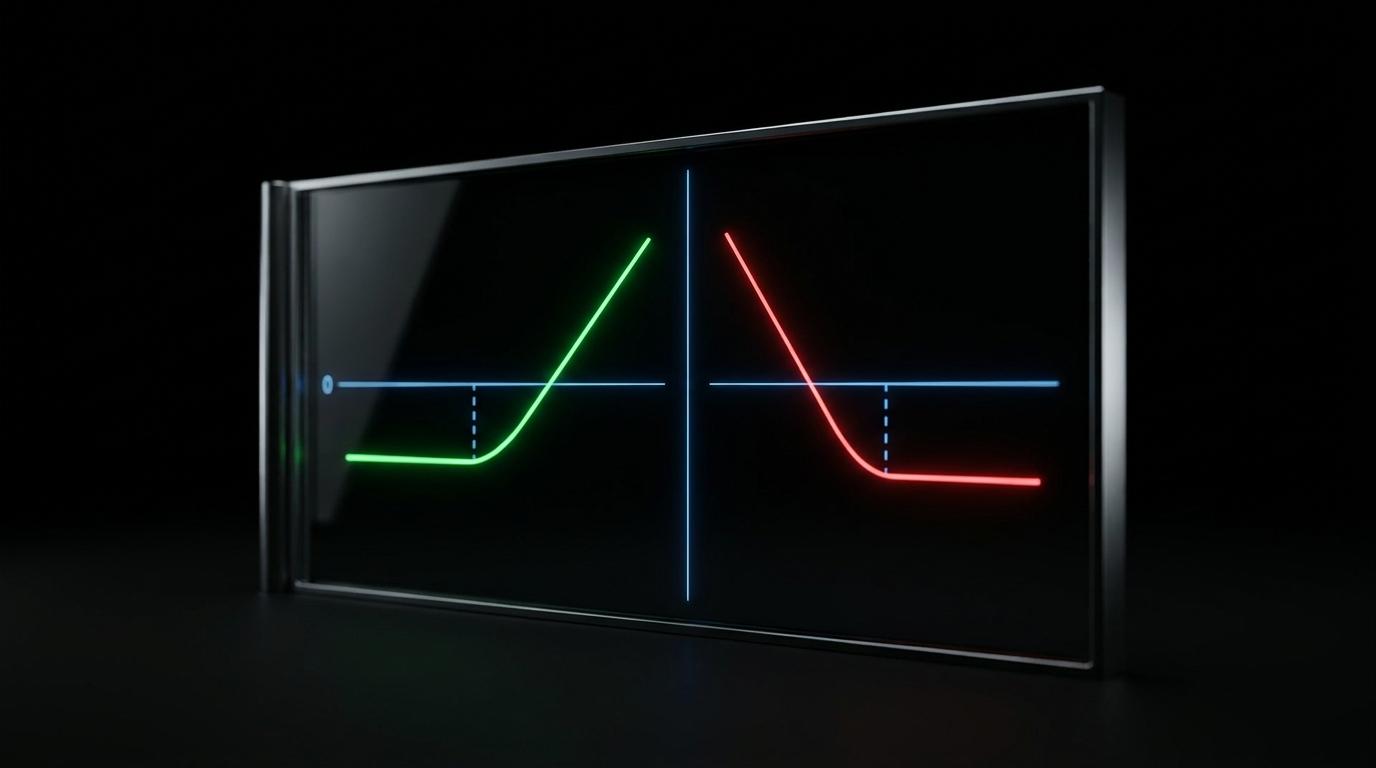
Take a European call and a European put on the same underlying, with the same strike and the same expiration. Hold the call and sell the put. At expiration, whatever the stock does, you end up owning 100 shares at the strike price:
- If the stock finishes above the strike, you exercise the call and buy at the strike.
- If it finishes below, the put is exercised against you and you buy at the strike.
There's no third outcome. That combination is a synthetic long stock position with a purchase price locked at the strike. So the cost of the combination today must equal the cost of buying the stock today, minus the benefit of not having to pay the strike until expiration.
That's the whole idea. Parity doesn't depend on volatility assumptions, on your view of the underlying, or on any of the model-driven sensitivities you'll find in our guide to delta, gamma, theta and vega. It follows from the payoff diagrams alone.
The put-call parity formula
The standard form, for European options on a non-dividend-paying underlying:
C − P = S − K × e^(−rT)
Where C is the call price, P is the put price, S is the current price of the underlying, K is the strike, r is the risk-free rate and T is the time to expiration in years. The term K × e^(−rT) is simply the present value of the strike.
Rearranged, it gives you each piece on its own:
- Call price: C = P + S − PV(K)
- Put price: P = C − S + PV(K)
- Stock price: S = C − P + PV(K)
The Options Industry Council's explanation of put/call parity walks through the same relationship with the arbitrage trades attached, which is a useful second pass if you want the formal version.
Why the strike is discounted
If you buy the synthetic (long call, short put), you don't pay the strike until expiration. That cash sits in your account earning interest in the meantime. Buying the stock outright means paying the full price today. The discount factor on K is what makes those two routes cost the same.
Higher rates widen the gap between calls and puts at the same strike, which is why calls get relatively more expensive as rates rise. Longer expirations do the same thing, since there's more time for that deferred payment to matter. On a weekly option, the effect is pennies. On a one-year LEAPS, it's real money.
A worked example
Say AMD trades at $160. You're looking at the 160-strike options expiring in 90 days (T = 0.25), with a 4% annualized rate.
Present value of the strike: 160 × e^(−0.04 × 0.25) = $158.41.
So C − P should be 160 − 158.41 = $1.59.
If the 160 call is quoted at $9.50, parity says the 160 put belongs near $7.91. If you instead see the put trading at $7.40, the combination is mispriced by about $0.51 per share, or $51 per contract. A market maker would sell the stock, buy the call and sell the put, lock the strike in, and collect that difference at expiration. In practice, quotes get pulled back into line long before you can click on them.
That's the honest takeaway for a retail trader: parity violations on liquid names are almost always an illusion created by stale quotes, a wide market, or a dividend you forgot about. Before you conclude you've found free money, check the mid prices rather than the last traded prints, because bid-ask spreads can easily be wider than the discrepancy you think you spotted.
Synthetic positions, built from parity
Rearranging the formula gives you six equivalences. Each one says a position can be replicated with different instruments:
Synthetic position | Built from |
|---|---|
Long stock | Long call + short put |
Short stock | Short call + long put |
Long call | Long stock + long put |
Long put | Short stock + long call |
Short call | Short stock + short put |
Short put | Long stock + short call |
A few of these you already trade without calling them synthetics. Holding shares and buying downside protection with a protective put produces a payoff curve that's identical in shape to simply owning a call at that strike. The max loss is capped, the upside runs, and the cost of the put plays the role of the call premium.
Running it the other way, a covered call is a synthetic short put: the payoff of long stock plus a short call matches that of a short put at the same strike, flat above and losing one-for-one below. That's why the risk profile of the two looks so familiar once you've drawn both.
The practical limit is permissions and capital. A trader who can only buy options has access to the long-only synthetics, while anything with a short leg or short stock requires the sort of approval that comes with a Level 4 account.
Where parity shows up in spreads
Parity also explains why vertical spreads built from calls and puts at the same two strikes carry the same risk. A bear put spread using the 420 and 400 strikes on MSFT and a bear call spread using those same strikes have the same maximum profit, same maximum loss and same breakeven. One is a debit, the other a credit, but the economics are identical because the difference between them is a position that's worth exactly its locked-in cash value.
The practical difference comes down to execution, not payoff: which side has tighter markets, which legs are more likely to be assigned early, and how much buying power each version ties up. Choosing between the debit and credit version of the same structure is a liquidity and assignment decision, not a directional one.
The same logic sits behind the box spread, which combines a bull call spread and a bear put spread at the same two strikes to create a position worth the strike width at expiration regardless of where the underlying lands. A box is parity made explicit — a cash loan dressed up as four option legs.
What breaks parity in the real world
The clean formula assumes European exercise, no dividends, no borrowing costs and frictionless trading. Loosen those and the equality becomes a range rather than a point.
Dividends. An expected dividend lowers the forward price of the stock, which lowers calls and raises puts. The adjusted formula subtracts the present value of dividends: C − P = S − PV(D) − PV(K). On a high-yield name, ignoring this makes puts look expensive when they're priced correctly.
American-style exercise. Equity and ETF options can be exercised at any time, and that early-exercise right has value. Parity becomes an inequality bounded on both sides rather than a strict equation. The gap is usually small, but it widens on deep in-the-money puts and around dividend dates.
Borrow costs. The arbitrage requires shorting the underlying on one side of the trade. Where shares are hard to borrow — as happens periodically with crypto-linked names such as MSTR — the borrow fee shows up as a persistent skew between calls and puts, and that's not a mispricing you can capture.
Index options. SPX and XSP are European-style and cash-settled with no dividend complication at the contract level, so parity holds there about as tightly as it holds anywhere in the listed market.
Using parity as a sanity check
You don't need to compute present values at the screen to get value from this. Three habits do most of the work:
- Compare the call and put at the same strike, not at equal distances from the money. Parity describes one strike. A put 5% below the money being more expensive than a call 5% above is volatility skew, not a parity violation.
- Infer the market's forward price. If the call is $1.59 richer than the put at the at-the-money strike, the market is telling you the forward sits about $1.59 above spot. Exchanges use this exact method to back out forward prices for index calculations.
- Pick the cheaper route to the same payoff. When you want long downside exposure, compare the outright long put against the synthetic version built from stock and a call, then trade whichever has the better fill. The payoffs match; the costs often don't.
Parity is one of the few ideas in options trading that's genuinely exact rather than approximate, which makes it a reliable backstop when quotes look strange.
FAQs
Does put-call parity hold for American options?
Not as a strict equality. Because American options can be exercised early, parity becomes a pair of inequalities that bracket the true relationship. For at-the-money and out-of-the-money contracts on names without dividends, the deviation is usually negligible. Deep in-the-money puts, and calls on stocks about to pay a dividend, are where the gap widens.
Why is the put more expensive than the call on the same underlying?
At the same strike, the put is worth more than the call whenever the present value of the strike exceeds the stock price plus carry effects — in other words, for strikes above the forward price. Across different strikes, puts generally carry higher implied volatility because of demand for downside protection, which is skew rather than parity.
Can a retail trader profit from parity violations?
Rarely. Conversions and reversals are low-margin, high-volume trades that depend on paying almost nothing in commissions, trading at the touch, and financing at institutional rates. Apparent violations on a retail screen are nearly always stale quotes or an unmodeled dividend.
How do dividends change the put-call parity formula?
Subtract the present value of dividends payable before expiration from the stock price: C − P = S − PV(D) − PV(K). The dividend transfers value from call holders to put holders, since a call holder doesn't receive it but the stock price drops on the ex-date.
Is put-call parity the same as a conversion?
A conversion is the trade that enforces parity. It's long stock, long put and short call at the same strike — a position with no directional exposure whose value is locked at expiration. A reversal is the mirror image. When prices drift away from parity, these are the trades that pull them back.
Put call parity won't tell you where a stock is going, but it will stop you from overpaying for a payoff you could build more cheaply, and it makes the link between calls, puts and the underlying obvious instead of mysterious. Once you can rearrange the relationship in your head, synthetics and spread equivalences stop needing to be memorized.
If you want to put that understanding to work on a funded path, Vanquish runs options-only evaluations with no daily loss limit and no time limit, and you can match the structures you trade to the permissions on each of the Vanquish plans.